
Filler Gone Wrong? Signs, Causes and What to Do Next
Medically reviewed by Jane Yoo, MD, board-certified dermatologist and Mohs surgeon.
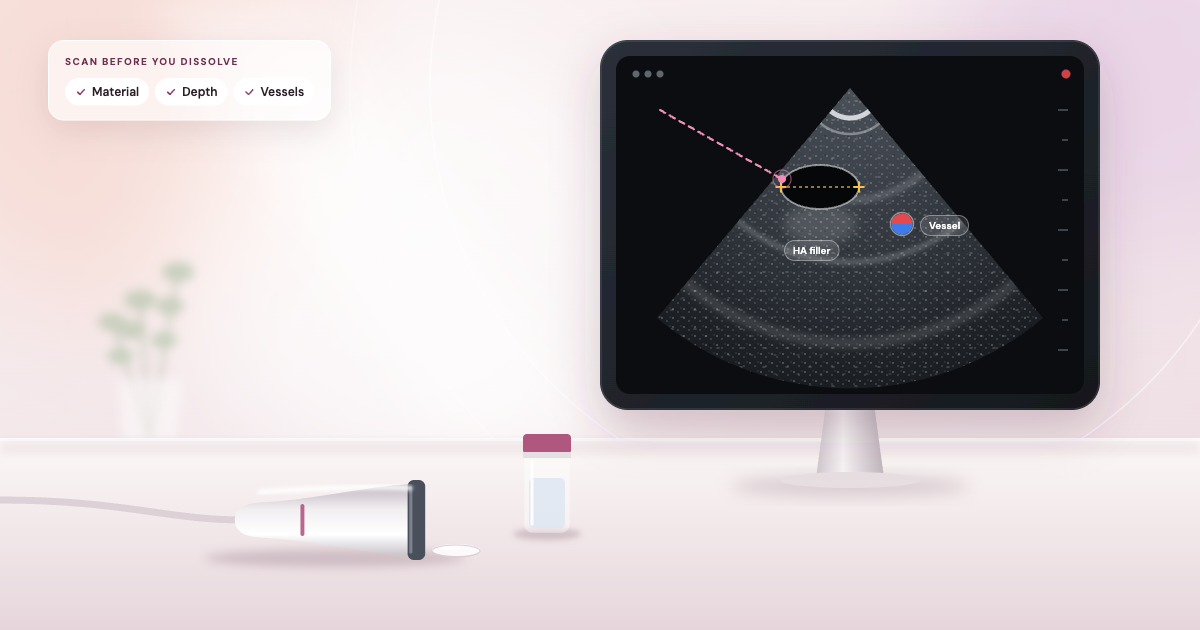
The short answer: most filler problems can be corrected, but you need to know what kind of filler you have and where it is now. The fastest way to find out is an ultrasound scan, which shows the material, its depth and the nearby blood vessels before any treatment begins.
When to get urgent help first
A rare but serious complication is a vascular occlusion, in which filler blocks or compresses a blood vessel. Seek emergency care immediately if, during or after filler, you notice:
- Severe or escalating pain
- Skin that turns pale, white, gray, blue or mottled
- Vision changes, eye pain or a drooping eyelid
- A dusky or lace-like pattern on the skin
Contact the injector right away and go to an emergency department. Do not wait to see if it settles.
Normal after filler versus a problem
|
Normal in the first days |
Worth a call |
|---|---|
|
Mild swelling and tenderness |
Swelling that is worsening after day 3 to 4 |
|
Small bruises |
Hard, painful or growing lumps |
|
Slight asymmetry that settles |
Lumps that appear weeks to months later |
|
Pinpoint marks at injection sites |
A bluish tint under the skin |
Common problems I see and what causes them
- Lumps and bumps. These can be filler that was placed too superficially, filler that has clumped, or an inflammatory reaction. Lumps that appear weeks or months later may be inflammatory in nature and need a careful assessment, not just a quick dissolving injection.
- A bluish or gray tint (the Tyndall effect). When hyaluronic acid filler sits too close to the surface, it can scatter light and show through as a blue-gray shadow. It is common under the eyes.
- Overfilled or puffy appearance. Often from cumulative volume added over several visits, sometimes by different providers.
- Migration. Filler can shift from where it was placed, for example lip filler moving above the lip line or cheek filler spreading.
- Persistent swelling. This is most often seen under the eyes and in the midface and deserves evaluation rather than waiting.
Why I scan with ultrasound before treating
Many patients arrive having already had filler injected or dissolved without imaging. The problem is that a needle cannot tell you what is under the skin. Ultrasound does.
- It identifies the material. Only hyaluronic acid (HA) filler can be dissolved with hyaluronidase. Fillers such as calcium hydroxylapatite, poly-L-lactic acid and PMMA do not respond to it, and need a different plan.
- It shows where the filler is now, which is often not where it was injected.
- It maps nearby blood vessels, which guides safer injection angles.
- It lets me use only what is needed. Published work on ultrasound-guided dissolving describes using targeted doses of hyaluronidase directly into the filler rather than flooding the area.
I describe my full approach in Why I Use Ultrasound for Every Filler Dissolution.
What treatment looks like
- History. I ask about every product, provider and date you can recall. Photos and treatment records help.
- Ultrasound scan. I map the filler, its depth and the vessels.
- A plan. If the filler is HA, hyaluronidase may be appropriate. If it is not, I will explain the alternatives, which may include waiting, other medications or referral.
- Targeted treatment. Hyaluronidase is placed according to the scan. Visible improvement begins within a day or two, and the full effect shows over about two weeks.
- Reassessment before any re-injection. If you want filler again, I would rather wait and rescan to plan placement.
See my full guides to ultrasound-guided filler dissolution in NYC and dissolving lip filler.
Can old filler be fixed?
Often, yes. HA filler can sometimes persist for years, and ultrasound is useful precisely because it shows what remains. A lump that has been present for a long time can still be assessed and treated.
What not to do
- Do not massage or squeeze a lump hard unless your injector told you to.
- Do not repeatedly add more filler to hide a problem.
- Do not have dissolving performed by someone who cannot tell you what filler you have and who is not prepared to manage complications.
Take the quick self-check
Not sure whether what you’re seeing is normal? Try my Filler Diagnostic, then book an evaluation if anything concerns you.
Frequently asked questions
Can all filler be dissolved? No. Only hyaluronic acid filler responds to hyaluronidase.
How soon should I act on a lump? A lump that is painful, red, warm or growing should be evaluated promptly. Stable, painless lumps still deserve assessment but are less urgent.
Will dissolving damage my own tissue? Hyaluronidase breaks down hyaluronic acid, including a small amount your skin naturally contains, which the body replaces. Precise, imaging-guided delivery limits unnecessary exposure.
How long until I can get filler again? I usually recommend waiting a few weeks and rescanning first.
Dealing with filler you are unhappy with? Book an ultrasound evaluation with Dr. Yoo in Midtown Manhattan.



Leave A Comment