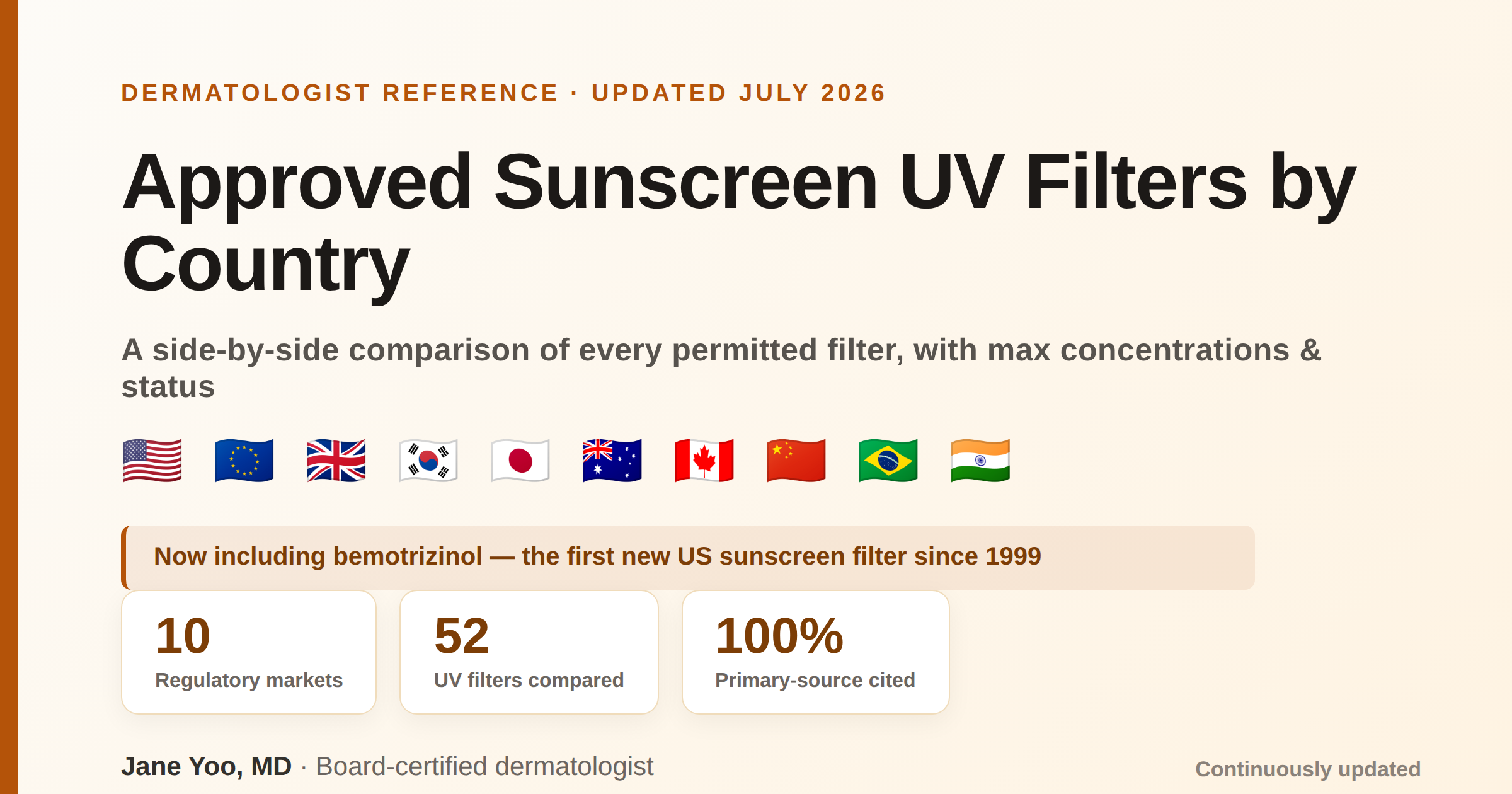
Approved Sunscreen UV Filters by Country
A side-by-side comparison of every permitted sunscreen filter across the US, EU, UK, South Korea, Japan, Australia, Canada, China, Brazil, and India — with maximum concentrations and current regulatory status. Compiled and maintained by Jane Yoo, MD, a board-certified dermatologist. Last updated July 17, 2026.
Sunscreen regulation is fragmented: a filter that anchors a Korean or European formula may be unavailable in the United States, capped at a different level, or on its way to a ban. This page tracks all of it in one place, across 10 regulatory markets and 52 UV filters, with primary sources cited.
10 markets at a glance
How many UV filters each regulator permits, and where each one is headed. A higher count doesn't mean stronger protection — Japan's total, for example, is inflated by obsolete legacy filters, while the EU and Korea lead on the modern broad-spectrum filters that matter most.
| Market | Regulator | Filters permitted | Regulatory posture |
|---|---|---|---|
| 🇺🇸 United States | FDA | 17 | Catching up — the fewest modern UVA filters; added bemotrizinol in 2026 |
| 🇪🇺 European Union | European Commission / SCCS | 29 | The broadest modern list; steadily tightening older filters (oxybenzone, homosalate, 4-MBC) |
| 🇬🇧 United Kingdom | OPSS / SAG-CS | 30 | EU-derived but diverging post-Brexit — kept homosalate at 10% and still allows 4-MBC |
| 🇰🇷 South Korea | MFDS | 32 | Fast-moving — three new filters added since 2024; cutting oxybenzone |
| 🇯🇵 Japan | MHLW | 35 | Organic-filter list static since 2019; several Japan-only filters; ZnO/TiO₂ uncapped |
| 🇦🇺 Australia | TGA | 28 | Therapeutic-goods model; actively restricting oxybenzone and homosalate (2025–26) |
| 🇨🇦 Canada | Health Canada | 21 | Monograph model; a broad modern list including both Tinosorbs and Mexoryls |
| 🇨🇳 China | NMPA | 26 | Aligning toward the EU — phased restrictions on 4-MBC, oxybenzone, homosalate (2027–28) |
| 🇧🇷 Brazil | ANVISA | 34 | Very permissive (Mercosur-harmonized) — still allows PABA and 4-MBC alongside all modern filters |
| 🇮🇳 India | CDSCO / BIS | 29 | Modeled on EU Annex VI (2022) — modern filters permitted; sunscreens are cosmetics |
Bemotrizinol: the first new US sunscreen filter in a generation
On June 10, 2026, the FDA issued final order OTC000039 recognizing bemotrizinol (Tinosorb S / PARSOL Shield) as GRASE at up to 6% — the first new active added to the US sunscreen monograph since 1999, and the first ever cleared through the CARES Act OTC monograph order-request pathway. The order takes effect August 9, 2026.
Bemotrizinol is a photostable, broad-spectrum filter used in the EU since 2000 and permitted in roughly 80 countries. It is allowed at 10% across the EU, UK, Korea, Australia, China, Brazil, and India — and has been for two decades. Its sister filter, bisoctrizole (Tinosorb M), remains pending in the US.
Related: FDA Sunscreen Filter Approval Tracker · Global Sunscreens Already Using BEMT: A Country-by-Country Guide
The short version (for journalists & citation)
As of July 2026, the world's major regulators permit very different sets of sunscreen UV filters. The United States — which in June 2026 approved bemotrizinol, its first new sunscreen active since 1999 — still lacks most modern UVA protection, including bisoctrizole (Tinosorb M), DHHB, and the Mexoryls, all routine in Europe and Asia. The European Union permits the broadest modern toolkit and is tightening older filters such as oxybenzone and homosalate on endocrine-activity grounds; South Korea moves fastest, adding three filters since 2024. Japan has not changed its organic-filter list since 2019. Regulators also disagree outright: 4-methylbenzylidene camphor is banned in the EU and (from 2027) China, yet remains legal in the UK, Korea, Australia, and Canada. Nor is the US gap limited to wealthy markets: Brazil (via a Mercosur-harmonized list) and India both permit the full modern toolkit that American consumers are only now beginning to get. The practical result is that no single sunscreen formula is legal, or optimal, in every market.
Permitted elsewhere, not in the US
The filters that define modern European and Korean sunscreens but are still missing from the US monograph even after bemotrizinol's approval:
- Bisoctrizole — Methylene Bis-Benzotriazolyl Tetramethylbutylphenol · 🇪🇺 🇬🇧 🇰🇷 🇯🇵 🇦🇺 🇨🇦 🇨🇳 🇧🇷 🇮🇳
- Ecamsule — Terephthalylidene Dicamphor Sulfonic Acid · 🇪🇺 🇬🇧 🇰🇷 🇯🇵 🇦🇺 🇨🇦 🇨🇳 🇧🇷 🇮🇳
- Mexoryl XL — Drometrizole Trisiloxane · 🇪🇺 🇬🇧 🇰🇷 🇯🇵 🇦🇺 🇨🇦 🇨🇳 🇧🇷 🇮🇳
- MCE — Methoxypropylamino Cyclohexenylidene Ethoxyethylcyanoacetate · 🇪🇺 🇬🇧 🇰🇷 🇦🇺 🇧🇷 🇮🇳
- DHHB — Diethylamino Hydroxybenzoyl Hexyl Benzoate · 🇪🇺 🇬🇧 🇰🇷 🇯🇵 🇦🇺 🇨🇳 🇧🇷 🇮🇳
- Uvinul T 150 — Ethylhexyl Triazone · 🇪🇺 🇬🇧 🇰🇷 🇯🇵 🇦🇺 🇨🇳 🇧🇷 🇮🇳
- Iscotrizinol — Diethylhexyl Butamido Triazone · 🇪🇺 🇬🇧 🇰🇷 🇨🇳 🇧🇷 🇮🇳
- Tinosorb A2B — Tris-Biphenyl Triazine · 🇪🇺 🇬🇧 🇰🇷 🇯🇵 🇦🇺 🇧🇷 🇮🇳
- TriAsorB — Phenylene Bis-Diphenyltriazine · 🇪🇺 🇬🇧 🇰🇷 🇧🇷 🇮🇳
- HAA299 — Bis-(Diethylaminohydroxybenzoyl Benzoyl) Piperazine · 🇪🇺 🇬🇧
- Parsol SLX — Polysilicone-15 · 🇪🇺 🇬🇧 🇰🇷 🇯🇵 🇦🇺 🇨🇳 🇧🇷 🇮🇳
- Bisdisulizole Disodium — Disodium Phenyl Dibenzimidazole Tetrasulfonate · 🇪🇺 🇬🇧 🇰🇷 🇦🇺 🇨🇳 🇧🇷 🇮🇳
- Amiloxate — Isoamyl p-Methoxycinnamate · 🇪🇺 🇬🇧 🇰🇷 🇦🇺 🇨🇳 🇧🇷 🇮🇳
- Enzacamene — 4-Methylbenzylidene Camphor · 🇬🇧 🇰🇷 🇦🇺 🇨🇦 🇧🇷 🇮🇳
- Uvinul P25 — PEG-25 PABA · 🇪🇺 🇬🇧 🇦🇺 🇨🇳 🇧🇷 🇮🇳
- Mexoryl SO — Camphor Benzalkonium Methosulfate · 🇪🇺 🇬🇧 🇨🇳 🇧🇷 🇮🇳
- Mexoryl SL — Benzylidene Camphor Sulfonic Acid · 🇪🇺 🇬🇧 🇨🇳 🇧🇷 🇮🇳
- Mexoryl SW — Polyacrylamidomethyl Benzylidene Camphor · 🇪🇺 🇬🇧 🇨🇳 🇧🇷 🇮🇳
- Drometrizole — Drometrizole · 🇰🇷
- Digalloyl Trioleate — Digalloyl Trioleate · 🇰🇷
- Ethyl Dihydroxypropyl PABA — Ethyl Dihydroxypropyl PABA · 🇰🇷
UVA / UVB spectral coverage
Where each major filter absorbs, across the UV spectrum (290–400 nm). Bars span each filter's effective absorbance range; the vertical tick marks its peak. Ranges are approximate, for illustration; mineral filters also scatter UV.
The complete UV filter comparison
Every cell shows the maximum permitted concentration for a leave-on skin sunscreen. Filter names link to their detailed profiles below.
6% Permitted (max %) New Newly approved Restr. Restricted — Not permitted Banned Prohibited
| UV filter | 🇺🇸 United States FDA | 🇪🇺 European Union European Commission / SCCS | 🇬🇧 United Kingdom OPSS / SAG-CS | 🇰🇷 South Korea MFDS | 🇯🇵 Japan MHLW | 🇦🇺 Australia TGA | 🇨🇦 Canada Health Canada | 🇨🇳 China NMPA | 🇧🇷 Brazil ANVISA | 🇮🇳 India CDSCO / BIS |
|---|---|---|---|---|---|---|---|---|---|---|
| Zinc Oxide ZnO | 25% | 25% | 25% | 25% | No limit | No limit | 25% | 25% | 25% | 25% |
| Titanium Dioxide TiO₂ | 25% | 25% | 25% | 25% | No limit | 25% | 25% | 25% | 25% | 25% |
| Bis-Ethylhexyloxyphenol Methoxyphenyl Triazine Bemotrizinol · Tinosorb S · PARSOL Shield · BEMT · Escalol S | 6% | 10% | 10% | 10% | 3% | 10% | 6% | 10% | 10% | 10% |
| Methylene Bis-Benzotriazolyl Tetramethylbutylphenol Bisoctrizole · Tinosorb M · MBBT | Not permitted | 10% | 10% | 10% | 10% | 10% | 5% | 10% | 10% | 10% |
| Butyl Methoxydibenzoylmethane Avobenzone · Parsol 1789 | 3% | 5% | 5% | 5% | 10% | 5% | 3% | 5% | 5% | 5% |
| Homosalate HMS | 15% | 7.34% | 10% | 10% | 10% | 15% | 15% | 10% | 15% | 10% |
| Ethylhexyl Methoxycinnamate Octinoxate · Octyl Methoxycinnamate · Parsol MCX · Uvinul MC80 | 7.5% | 10% | 10% | 7.5% | 20% | 10% | 7.5% | 10% | 10% | 10% |
| Ethylhexyl Salicylate Octisalate · Octyl Salicylate · Neo Heliopan OS | 5% | 5% | 5% | 5% | 10% | 5% | 5% | 5% | 5% | 5% |
| Octocrylene Uvinul N539T | 10% | 10% | 10% | 10% | 10% | 10% | 10% | 10% | 10% | 10% |
| Benzophenone-3 Oxybenzone · Uvinul M40 · Eusolex 4360 | 6% | 6% face / 2.2% body | 6% face / 2.2% body | 2.4% (5% face/hands/lips) | 5% (leave-on) | 10% | 6% | 10% | 10% | 6% |
| Phenylbenzimidazole Sulfonic Acid Ensulizole · Eusolex 232 · Parsol HS | 4% | 8% | 8% | 4% | 3% | 4% | 4% | 8% | 8% | 8% |
| Terephthalylidene Dicamphor Sulfonic Acid Ecamsule · Mexoryl SX | NDA only | 10% | 10% | 10% | 10% | 10% | 10% | 10% | 10% | 10% |
| Drometrizole Trisiloxane Mexoryl XL | Not permitted | 15% | 15% | 15% | 15% | 15% | 15% | 15% | 15% | 15% |
| Methoxypropylamino Cyclohexenylidene Ethoxyethylcyanoacetate MCE · Mexoryl 400 | Not permitted | 3% | 3% | 3% | Not permitted | 3% | Not permitted | Not permitted | 3% | 3% |
| Diethylamino Hydroxybenzoyl Hexyl Benzoate DHHB · Uvinul A Plus | Not permitted | 10% | 10% | 10% | 10% | 10% | Not permitted | 10% | 10% | 10% |
| Ethylhexyl Triazone Uvinul T 150 · Octyl Triazone | Not permitted | 5% | 5% | 5% | 5% | 5% | Not permitted | 5% | 5% | 5% |
| Diethylhexyl Butamido Triazone Iscotrizinol · Uvasorb HEB · DBT | Not permitted | 10% | 10% | 10% | Not permitted | Not permitted | Not permitted | 10% | 10% | 10% |
| Tris-Biphenyl Triazine Tinosorb A2B | Not permitted | 10% | 10% | 10% | 10% | 10% | Not permitted | Not permitted | 10% | 10% |
| Phenylene Bis-Diphenyltriazine TriAsorB · PBDT | Not permitted | 5% | 5% | 5% | Not permitted | Not permitted | Not permitted | Not permitted | 5% | 5% |
| Bis-(Diethylaminohydroxybenzoyl Benzoyl) Piperazine HAA299 | Not permitted | 10% | 10% | Not permitted | Not permitted | Not permitted | Not permitted | Not permitted | Not permitted | Not permitted |
| Polysilicone-15 Parsol SLX | Not permitted | 10% | 10% | 10% | 10% | 10% | Not permitted | 10% | 10% | 10% |
| Disodium Phenyl Dibenzimidazole Tetrasulfonate Bisdisulizole Disodium · Neo Heliopan AP · DPDT | Not permitted | 10% | 10% | 10% | Not permitted | 10% | Not permitted | 10% | 10% | 10% |
| Isoamyl p-Methoxycinnamate Amiloxate · Neo Heliopan E1000 | Not permitted | 10% | 10% | 10% | Not permitted | 10% | Not permitted | 10% | 10% | 10% |
| 4-Methylbenzylidene Camphor Enzacamene · 4-MBC · Eusolex 6300 · Parsol 5000 | Not permitted | Banned | 4% | 4% | Not permitted | 4% | 4% | 4% | 4% | 4% |
| Benzophenone-4 (and BP-5) Sulisobenzone · Uvinul MS40 | 10% | 5% | 5% | 5% | 10% | 10% | 10% | 5% | 10% | 5% |
| Benzophenone-8 Dioxybenzone | 3% | Not permitted | Not permitted | 3% | Not permitted | 3% | 3% | Not permitted | 3% | Not permitted |
| Menthyl Anthranilate Meradimate | 5% | Not permitted | Not permitted | 5% | Not permitted | 5% | 5% | Not permitted | 5% | Not permitted |
| Cinoxate | 3% | Not permitted | Not permitted | 5% | 5% (leave-on) | 6% | 3% | Not permitted | 3% | Not permitted |
| Ethylhexyl Dimethyl PABA Padimate O · Eusolex 6007 | 8% | 8% | 8% | 8% | 10% | 8% | 8% | 8% | 8% | 8% |
| PABA (Aminobenzoic Acid) para-Aminobenzoic acid | 15%* | Banned | Banned | Not permitted | 4% | Uncertain | Not permitted | Not permitted | 15% | Not permitted |
| TEA-Salicylate Trolamine Salicylate | 12%* | Not permitted | Not permitted | 12% | Not permitted | 12% | 12% | Not permitted | 12% | Not permitted |
| PEG-25 PABA Uvinul P25 | Not permitted | 10% | 10% | Not permitted | See note | 10% | Not permitted | 10% | 10% | 10% |
| DEA-Methoxycinnamate | Not permitted | Not permitted | Not permitted | Not permitted | Not permitted | Not permitted | 10% | Not permitted | Not permitted | Not permitted |
| Camphor Benzalkonium Methosulfate Mexoryl SO | Not permitted | 6% | 6% | Not permitted | Not permitted | Not permitted | Not permitted | 6% | 6% | 6% |
| Benzylidene Camphor Sulfonic Acid Mexoryl SL | Not permitted | 6% | 6% | Not permitted | Not permitted | Not permitted | Not permitted | 6% | 6% | 10% |
| Polyacrylamidomethyl Benzylidene Camphor Mexoryl SW | Not permitted | 6% | 6% | Not permitted | Not permitted | Not permitted | Not permitted | 6% | 6% | 6% |
| Drometrizole | Not permitted | Not permitted | Not permitted | 1% | Not permitted | Not permitted | Not permitted | Not permitted | Not permitted | Not permitted |
| Digalloyl Trioleate | Not permitted | Not permitted | Not permitted | 5% | Not permitted | Not permitted | Not permitted | Not permitted | Not permitted | Not permitted |
| Ethyl Dihydroxypropyl PABA | Not permitted | Not permitted | Not permitted | 5% | Not permitted | Not permitted | Not permitted | Not permitted | Not permitted | Not permitted |
| Glyceryl Ethylhexanoate Dimethoxycinnamate | Not permitted | Not permitted | Not permitted | Not permitted | 10% | Not permitted | Not permitted | Not permitted | Not permitted | Not permitted |
| Isopentyl Trimethoxycinnamate Trisiloxane | Not permitted | Not permitted | Not permitted | Not permitted | 7.5% | Not permitted | Not permitted | Not permitted | Not permitted | Not permitted |
| Ferulic Acid | Not permitted | Not permitted | Not permitted | Not permitted | 10% | Not permitted | Not permitted | Not permitted | Not permitted | Not permitted |
| Ethylhexyl Dimethoxybenzylidene Dioxoimidazolidine Propionate | Not permitted | Not permitted | Not permitted | Not permitted | 3% | Not permitted | Not permitted | Not permitted | Not permitted | Not permitted |
| Methyl 2,5-Diisopropylcinnamate | Not permitted | Not permitted | Not permitted | Not permitted | 10% | Not permitted | Not permitted | Not permitted | Not permitted | Not permitted |
| Isopropyl Methoxycinnamate (mixture) | Not permitted | Not permitted | Not permitted | Not permitted | 10% | Not permitted | Not permitted | Not permitted | Not permitted | Not permitted |
| 2-Methylphenyl 4-Methoxycinnamate | Not permitted | Not permitted | Not permitted | Not permitted | 10% | Not permitted | Not permitted | Not permitted | Not permitted | Not permitted |
| 1-(3,4-Dimethoxyphenyl)-4,4-dimethyl-1,3-pentanedione | Not permitted | Not permitted | Not permitted | Not permitted | 7% | Not permitted | Not permitted | Not permitted | Not permitted | Not permitted |
| 4-(2-β-Glucopyranosiloxy)propoxy-2-hydroxybenzophenone | Not permitted | Not permitted | Not permitted | Not permitted | 5% | Not permitted | Not permitted | Not permitted | Not permitted | Not permitted |
| Benzophenone-1 | Not permitted | Not permitted | Not permitted | Not permitted | 10% | Not permitted | Not permitted | Not permitted | Not permitted | Not permitted |
| Benzophenone-2 | Not permitted | Not permitted | Not permitted | Not permitted | 10% | Not permitted | Not permitted | Not permitted | Not permitted | Not permitted |
| Benzophenone-6 | Not permitted | Not permitted | Not permitted | Not permitted | 10% | Not permitted | Not permitted | Not permitted | Not permitted | Not permitted |
| Benzophenone-9 | Not permitted | Not permitted | Not permitted | Not permitted | 10% | Not permitted | Not permitted | Not permitted | Not permitted | Not permitted |
Filter-by-filter profiles
Mechanism, spectral behavior, regulatory and safety history, and formulation role for the major filters.
Zinc Oxide (ZnO)
UV coverage: Broad spectrum (UVB + UVA1 + UVA2) · Photostability: Yes
One of only two filters FDA proposed as Category I GRASE (safe and effective) in its 2021 proposed order. EU permits nano and non-nano forms with conditions (not in applications leading to inhalation exposure).
How it works. A mineral (inorganic) filter that provides genuine broad-spectrum protection — the only single filter covering UVB through UVA1 — primarily by absorption, with some scattering. Photostable and non-reactive.
Regulatory & safety history. One of only two filters the FDA proposed as Category I (GRASE) in its 2021 proposed order; permitted at ~25% worldwide. The nano vs. non-nano debate has shaped EU/Canada rules (combined caps, particle-size and coating conditions), while Japan places no numeric cap because inorganic filters sit outside its organic-absorber positive list.
Formulation role. Sensorially heavier and prone to a white cast at high loads; modern grades and dispersions mitigate this. The backbone of 'mineral' and sensitive-skin sunscreens and the default where organic-filter avoidance is desired.
Jurisdiction notes:
- 🇺🇸 United States: Proposed GRASE Category I (2021 proposed order)
- 🇪🇺 European Union: Incl. nano (entry 30a) with purity/particle-size conditions; not in inhalable applications
- 🇬🇧 United Kingdom: Same as EU baseline
- 🇯🇵 Japan: Not on the Appendix 4 positive list because Japan's list covers organic UV absorbers only — inorganic filters are unrestricted (general safety obligation applies)
- 🇦🇺 Australia: No specified concentration limit in TGA permitted-agents table
- 🇨🇦 Canada: Nano + non-nano combined must not exceed 25%
- 🇨🇳 China: No separate nano entry
Titanium Dioxide (TiO₂)
UV coverage: UVB + UVA2 (attenuates less at long UVA1) · Photostability: Yes
The second FDA Category I GRASE filter. EU restricts certain pigmentary powder forms (Reg. 2021/850); the UK did not adopt that restriction.
How it works. A mineral filter that protects mainly across UVB and UVA2 by absorption and scattering. Strong short-wavelength performance but weaker at long UVA1 than zinc oxide, so the two are often combined.
Regulatory & safety history. The second FDA Category I (GRASE) filter. The EU restricted certain pigmentary powder forms (Reg. 2021/850) on inhalation-safety grounds; the UK did not adopt that restriction — a concrete post-Brexit divergence. Nano grades carry strict purity, coating and photostability conditions in the EU.
Formulation role. Requires coating to suppress photocatalytic activity that could otherwise generate free radicals. Common in mineral and tinted sunscreens; frequently paired with zinc oxide to close its UVA1 gap.
Jurisdiction notes:
- 🇺🇸 United States: Proposed GRASE Category I (2021 proposed order)
- 🇪🇺 European Union: Nano entry 27a with strict conditions; pigmentary powder forms restricted per Reg. 2021/850
- 🇬🇧 United Kingdom: GB did not adopt EU Reg. 2021/850 powder restrictions
- 🇯🇵 Japan: Inorganic filters are outside Japan's positive-list system — no statutory cap
- 🇦🇺 Australia: Per TGA permitted-agents table; verify current Permissible Ingredients Determination
- 🇨🇦 Canada: Nano + non-nano combined must not exceed 25%
Bis-Ethylhexyloxyphenol Methoxyphenyl Triazine (Bemotrizinol · Tinosorb S · PARSOL Shield · BEMT · Escalol S)
UV coverage: Broad spectrum (UVB + UVA1 + UVA2), peaks ~310 and ~343 nm · Photostability: Yes — also stabilizes avobenzone
The first new active added to the US sunscreen monograph since 1999. FDA final order OTC000039 issued June 10, 2026, effective August 9, 2026, at up to 6%. Approved in the EU since 2000 and used in ~80+ countries. US restrictions: not combinable with PABA or trolamine salicylate; permitted in most dosage forms except propellant aerosols and powders; DSM holds ~18 months of marketing exclusivity from the effective date.
How it works. A symmetric triazine that absorbs across the UVB and UVA range through a highly conjugated, resonance-stabilized system. It dissipates absorbed UV energy as heat and returns to its ground state without breaking down — the definition of a photostable filter — and it can donate that stability to less robust partners in a formula.
Regulatory & safety history. Introduced in Europe in 2000 (Ciba's Tinosorb S; also sold as DSM's PARSOL Shield) and adopted across ~80 countries over the following two decades. In the US it sat in the sunscreen backlog from a 2005 TEA filing until DSM-Firmenich filed the first-ever CARES Act order request in 2024; the FDA issued a final GRASE order at 6% on June 10, 2026 (effective August 9, 2026) — the first new US sunscreen active since 1999. FDA maximal-usage-trial data supported low systemic absorption.
Formulation role. Oil-soluble; a cornerstone broad-spectrum filter in modern European and Asian sunscreens. Frequently paired with avobenzone (which it photostabilizes) and with bisoctrizole for full broad-spectrum coverage. Its higher cost and its long US absence are why American formulas historically leaned on octocrylene/oxybenzone instead.
Jurisdiction notes:
- 🇺🇸 United States: GRASE by final order June 10, 2026; effective Aug 9, 2026. First new US filter since 1999. Expect first US products late 2026–2027.
- 🇪🇺 European Union: Annex VI entry 25; approved since 2000
- 🇯🇵 Japan: Notably low 3% cap — the biggest Japan/Korea divergence; prohibited in mucosa-contact products
- 🇦🇺 Australia: Approved in Australia for over two decades
- 🇨🇦 Canada: In Primary Sunscreen Monograph; also added to Secondary Monograph (Dec 2025 revision) for hybrid/cosmetic-like products
Methylene Bis-Benzotriazolyl Tetramethylbutylphenol (Bisoctrizole · Tinosorb M · MBBT)
UV coverage: Broad spectrum (UVB + UVA1 + UVA2) · Photostability: Yes
Bemotrizinol's sister filter. A US TEA application has been pending since 2005 (FDA feedback letter 2014); widely expected to be the next OMOR candidate, but no submission has been made as of July 2026.
How it works. A hybrid 'organic particulate' filter: microfine insoluble particles that both absorb UV (like an organic filter) and scatter it (like a mineral), giving broad UVB-through-UVA1 protection with excellent photostability.
Regulatory & safety history. Ciba's Tinosorb M, EU-approved since the early 2000s and standard across the EU, UK, Korea, Japan (added 2017), Australia, Canada and China. Its US TEA has been pending since 2005; despite a 2014 FDA feedback letter it has not advanced, and no order request has been filed — leaving it the most conspicuous modern filter still unavailable to US formulators after bemotrizinol's approval.
Formulation role. Supplied as an aqueous dispersion, so it partitions into the water phase and pairs naturally with oil-soluble filters. Prized for cosmetic elegance and broad coverage; its particulate nature means formulation (not just inclusion) drives performance.
Jurisdiction notes:
- 🇺🇸 United States: TEA pending since 2005; no OMOR submitted as of July 2026
- 🇪🇺 European Union: Incl. nano (entry 23a) with conditions
- 🇯🇵 Japan: Added 2017; prohibited in mucosa-contact products
- 🇨🇦 Canada: Primary Sunscreen Monograph — note lower 5% cap vs 10% elsewhere
Butyl Methoxydibenzoylmethane (Avobenzone · Parsol 1789)
UV coverage: UVA1 (peak ~357 nm) — the workhorse UVA filter in US formulas · Photostability: No — degrades in sunlight unless stabilized (e.g., with octocrylene or bemotrizinol)
The only strong UVA1 filter available in the US until bemotrizinol. Note the spread: 3% US/Canada vs 5% EU/Korea/Australia vs 10% Japan.
How it works. A dibenzoylmethane that is the most efficient UVA1 absorber among conventional organic filters, with peak absorbance near 357 nm. It works via keto-enol tautomerism — but the excited state can undergo irreversible photodegradation, so it loses efficacy in sunlight unless stabilized.
Regulatory & safety history. The workhorse UVA filter of US sunscreens (avobenzone) because, until 2026, it was the only strong UVA1 organic filter in the monograph. FDA's 2019–2020 maximal-usage trials (Matta et al., JAMA) found measurable systemic absorption, one driver of the agency's call for more data on older filters. Capped at just 3% in the US/Canada vs 5% in the EU and 10% in Japan.
Formulation role. Notoriously photounstable and incompatible with octinoxate (which accelerates its breakdown). Must be photostabilized — classically with octocrylene, and increasingly with bemotrizinol, bisoctrizole or DHHB. Its US concentration cap and instability are a major reason American UVA protection has lagged.
Jurisdiction notes:
- 🇺🇸 United States: 2021 proposed order: Category III (more data needed); remains marketable
- 🇯🇵 Japan: Highest cap of any major market
- 🇦🇺 Australia: TGA 2025 safety review: low risk
- 🇮🇳 India: IS 4707 (Part 4):2022 OCR text reads 6%; the EU-aligned value is 5% — exact digit to be confirmed against the official BIS copy
Homosalate (HMS)
UV coverage: UVB · Photostability: Moderate
The clearest US–EU divergence in the table. The EU cut homosalate to 7.34% in face products only (endocrine-activity concerns, SCCS); the UK deliberately kept 10% for all product types after its own SAG-CS review found it safe; Australia's TGA proposed face/hands-only restrictions in 2025 (decision still pending); China will adopt the EU limit on Jan 1, 2028.
How it works. A salicylate UVB absorber, weak on its own but valued as an oil-phase solvent that dissolves other filters (notably avobenzone and oxybenzone), making it a formulation enabler as much as a filter.
Regulatory & safety history. The clearest US–EU split in the table. The EU cut it to 7.34% in face products only (2022, endocrine-activity concerns); the UK reviewed the same evidence and deliberately kept 10% for all products; Australia's TGA proposed face/hands restrictions in 2025 (decision delayed); China adopts the EU limit in 2028. The US still allows 15%.
Formulation role. Its solvency makes it hard to remove from legacy formulas without reworking the whole filter system — a big reason the EU's cut forced reformulation across the industry.
Jurisdiction notes:
- 🇺🇸 United States: Category III in 2021 proposed order; remains marketable at 15%
- 🇪🇺 European Union: Face products only (except propellant sprays), per Reg. 2022/2195; body use no longer permitted. Fully applicable since mid-2025
- 🇬🇧 United Kingdom: Deliberate post-Brexit divergence — SAG-CS Opinion 17 (2025) found 10% safe for all product types. NI follows the EU rule
- 🇦🇺 Australia: TGA 2025 review found inadequate safety margin at full-body 15%; restriction proposed Sep 2025, final decision delayed — 15% remains legal as of July 2026
- 🇨🇳 China: From Jan 1, 2028: 7.34%, face products only (non-aerosol) — EU-aligned
- 🇧🇷 Brazil: vs 7.34% (face only) in the EU
- 🇮🇳 India: vs 7.34% (face only) in the EU
Ethylhexyl Methoxycinnamate (Octinoxate · Octyl Methoxycinnamate · Parsol MCX · Uvinul MC80)
UV coverage: UVB (peak ~311 nm) · Photostability: No — degrades and can destabilize avobenzone
Banned in Hawaii reef legislation contexts (state law, not FDA). SCCS re-confirmed 10% as safe in the EU (final opinion June 2025). Japan allows up to 20% — the world's highest cap.
How it works. A cinnamate and, historically, the most widely used UVB filter globally. Absorbs efficiently near 311 nm but is photolabile — it isomerizes and degrades in sunlight and destabilizes avobenzone.
Regulatory & safety history. Octinoxate is the filter at the center of 'reef-safe' legislation (Hawaii and others banned it at the state level, independent of FDA). The EU's SCCS re-confirmed safety at 10% in 2025. Concentration caps span 7.5% (US/Korea) to 10% (EU/China) to Japan's world-high 20%.
Formulation role. Cheap, effective and cosmetically light, but its photoinstability and avobenzone incompatibility have pushed premium formulas toward newer UVB filters like ethylhexyl triazone.
Jurisdiction notes:
- 🇺🇸 United States: Category III in 2021 proposed order
- 🇪🇺 European Union: SCCS/1671/24 (June 2025) re-confirmed safety at 10%
- 🇯🇵 Japan: 8% in mucosa-contact products
- 🇦🇺 Australia: TGA 2025 review: low risk
Ethylhexyl Salicylate (Octisalate · Octyl Salicylate · Neo Heliopan OS)
UV coverage: UVB (weak; used as co-filter and solubilizer) · Photostability: Yes
Near-universal 5% cap; Japan allows 10% in non-mucosa products.
How it works. A salicylate UVB filter — weak absorber but photostable and an effective oil-phase solvent for other filters, much like homosalate.
Regulatory & safety history. Octisalate is near-universally permitted at 5% (10% in Japan for non-mucosal products) and has largely escaped the safety scrutiny aimed at oxybenzone and homosalate.
Formulation role. Used as much for its solubilizing role as for SPF; a quiet, reliable component of most broad-spectrum systems worldwide.
Jurisdiction notes:
- 🇺🇸 United States: Category III in 2021 proposed order
- 🇯🇵 Japan: 5% in mucosa-contact products
Octocrylene (Uvinul N539T)
UV coverage: UVB + short UVA2; stabilizes avobenzone · Photostability: Yes
Survived recent safety reviews largely intact: EU trimmed only propellant sprays to 9%; TGA (2025) found it low-risk; benzophenone-impurity concerns drove headlines but not delistings. China adopts the EU spray limit in 2028.
How it works. A UVB/short-UVA2 absorber that is itself photostable and, importantly, an excellent photostabilizer for avobenzone — one reason it appears in so many US broad-spectrum products.
Regulatory & safety history. Survived recent safety reviews largely intact: the EU trimmed only propellant sprays to 9%; Australia's 2025 review rated it low-risk. Headlines about benzophenone forming as a degradation impurity over time drove consumer concern but not delistings; China adopts the EU spray limit in 2028.
Formulation role. A near-default avobenzone stabilizer in the US precisely because bemotrizinol and bisoctrizole weren't available. Can contribute to a heavier skin feel at high use levels.
Jurisdiction notes:
- 🇺🇸 United States: Category III in 2021 proposed order
- 🇪🇺 European Union: 9% in propellant spray products (Reg. 2022/1176)
- 🇬🇧 United Kingdom: GB did not mirror the EU 9% propellant-spray sub-limit
- 🇦🇺 Australia: TGA 2025 review: low risk, no change
- 🇨🇳 China: From Jan 1, 2028: 9% in aerosol/propellant sprays
Benzophenone-3 (Oxybenzone · Uvinul M40 · Eusolex 4360)
UV coverage: UVB + UVA2 · Photostability: Yes
The most restricted-in-motion filter worldwide. EU cut body products to 2.2% (2022); the UK mirrored that only in January 2026; Korea cut to 2.4% (5% face/hands/lips) effective 2026; Australia's TGA proposed face/hands-only limits (in progress); China follows the EU limits from 2028. FDA's own MUsT studies flagged high systemic absorption. EU/China require a 'Contains Benzophenone-3' label.
How it works. A benzophenone absorbing in both UVB and UVA2. Photostable as a filter, but the most systemically absorbed of the common actives.
Regulatory & safety history. The most 'in-retreat' filter worldwide. FDA's 2019–2020 maximal-usage trials found oxybenzone plasma levels far above the agency's 0.5 ng/mL toxicology threshold, and endocrine-activity and environmental concerns have driven restrictions: EU cut body products to 2.2% (2022), the UK mirrored that only in January 2026, Korea cut to 2.4%, Australia is restricting it, and China follows the EU from 2028. Also named in reef-protection laws.
Formulation role. Effective and cheap but increasingly a liability for brand positioning; the EU and China require a 'Contains Benzophenone-3' label. Many brands have already reformulated it out.
Jurisdiction notes:
- 🇺🇸 United States: Category III; FDA MUsT data showed significant systemic absorption
- 🇪🇺 European Union: 6% face/hand/lip (non-spray); 2.2% body incl. sprays; 0.5% for product protection; warning label required (Reg. 2022/1176)
- 🇬🇧 United Kingdom: Mirrored EU limits via SI 2025/901, in force Jan 21, 2026; sell-through ended Jul 21, 2026
- 🇰🇷 South Korea: Lowered from 5% by Notification 2025-63, effective ~Mar 2026
- 🇯🇵 Japan: No limit in rinse-off products; 5% mucosa
- 🇦🇺 Australia: TGA 2025 review: inadequate margin for full-body use; restriction to ~face/hands proposed and reportedly proceeding — 10% still legal as of July 2026
- 🇨🇳 China: 'Contains Benzophenone-3' label required. From Jan 1, 2028: 6% face / 2.2% body (EU-aligned)
- 🇧🇷 Brazil: Label warning required if >0.5%; vs 6%/2.2% in the EU
- 🇮🇳 India: Matches the EU's reduced 6% limit
Phenylbenzimidazole Sulfonic Acid (Ensulizole · Eusolex 232 · Parsol HS)
UV coverage: UVB · Photostability: Yes
Water-soluble UVB filter common in light lotions and gels. Note the 2x spread: 8% EU/China vs 4% US/Korea/Australia/Canada vs 3% Japan.
How it works. A water-soluble UVB filter that partitions into the aqueous phase, letting formulators boost UVB/SPF without adding to the oil load — useful for light, fast-absorbing textures.
Regulatory & safety history. Ensulizole is broadly permitted, with a notable 2x spread in caps: 8% in the EU/China, 4% in the US/Korea/Australia/Canada, 3% in Japan. Australia's 2025 review rated it low-risk.
Formulation role. Requires neutralization to solubilize and is UVB-only, so it is a supporting filter rather than a standalone; common in gels and hybrid moisturizer-sunscreens.
Jurisdiction notes:
- 🇺🇸 United States: Category III in 2021 proposed order
- 🇪🇺 European Union: As acid
- 🇯🇵 Japan: Prohibited in mucosa-contact products
- 🇦🇺 Australia: TGA 2025 review: low risk
- 🇨🇳 China: Incl. K/Na/TEA salts, as acid
Terephthalylidene Dicamphor Sulfonic Acid (Ecamsule · Mexoryl SX)
UV coverage: UVA2 (peak ~345 nm) · Photostability: Yes
L'Oréal's flagship UVA filter. In the US it was approved only through a 2006 NDA for specific Anthelios formulas (never added to the monograph); those NDA products appear discontinued, so it is effectively unavailable in the US today.
How it works. A water-soluble UVA2 filter (peak ~345 nm) built on a camphor-sulfonic acid backbone; photostable and effective in the short-UVA range where many UVB filters fall off.
Regulatory & safety history. L'Oréal's Mexoryl SX. In the US it was approved only through a 2006 NDA for specific Anthelios products — never added to the monograph — and those products appear discontinued, so it is effectively unavailable to US consumers today. Freely permitted at 10% across the EU, UK, Korea, Japan, Australia, Canada and China.
Formulation role. Water-phase filter, so it complements oil-soluble UVA1 filters; a signature of L'Oréal-group UVA systems, often alongside avobenzone and drometrizole trisiloxane.
Jurisdiction notes:
- 🇺🇸 United States: Approved 2006 via NDA 021502 for specific L'Oréal products only; not in the OTC monograph; TEA route dormant; NDA products appear discontinued
- 🇪🇺 European Union: As acid
- 🇰🇷 South Korea: Incl. salts, as acid
- 🇯🇵 Japan: Prohibited in mucosa-contact products
- 🇨🇳 China: Incl. salts, as acid
Drometrizole Trisiloxane (Mexoryl XL)
UV coverage: Broad (UVB + UVA), dual-peak ~303 and ~344 nm · Photostability: Yes
L'Oréal's patented photostable broad-spectrum filter, permitted at a generous 15% in every major market except the US, where its TEA has been dormant since a 2014 FDA feedback letter.
How it works. A benzotriazole on a siloxane backbone giving dual-peak, broad UVB-plus-UVA absorption with strong photostability and skin substantivity.
Regulatory & safety history. L'Oréal's patented Mexoryl XL, permitted at a generous 15% in every major market except the US, where its TEA has been dormant since a 2014 FDA feedback letter. Canada now lists it in the general monograph rather than restricting it to L'Oréal drug submissions.
Formulation role. Oil-soluble and highly photostable; pairs with the water-soluble Mexoryl SX to give L'Oréal-group sunscreens their broad, robust protection profile.
Jurisdiction notes:
- 🇺🇸 United States: TEA pending; FDA feedback letter Aug 2014; dormant
- 🇯🇵 Japan: Prohibited in mucosa-contact products
- 🇨🇦 Canada: In current Primary Monograph — no longer limited to L'Oréal drug submissions
Methoxypropylamino Cyclohexenylidene Ethoxyethylcyanoacetate (MCE · Mexoryl 400)
UV coverage: Ultra-long UVA1 (peak ~385 nm, coverage to 400 nm) · Photostability: Yes
The newest-generation UVA1 filter (L'Oréal UVMune 400 line). Added to the EU list in 2020, Korea in ~2024. Conditions: not for inhalable products; strict nitrosamine controls.
How it works. A next-generation filter engineered for ultra-long UVA1, peaking near 385 nm and extending protection toward 400 nm — the region linked to pigmentation and photoaging that older UVA filters cover poorly.
Regulatory & safety history. L'Oréal's Mexoryl 400 (marketed in the UVMune 400 line). Added to the EU list in 2020 and Korea around 2024 — Korea's first new filter since 2018. Not permitted in the US, Japan, Canada or China. Carries nitrosamine-control and no-inhalation conditions.
Formulation role. Fills a genuine spectral gap at the long-UVA edge; its arrival prompted a wave of 'to 400 nm' marketing and reformulation in Europe and Asia.
Jurisdiction notes:
- 🇺🇸 United States: No TEA/OMOR on file
- 🇪🇺 European Union: Added by Reg. 2020/1684; nitrosamine and no-inhalation conditions
- 🇬🇧 United Kingdom: In GB retained list (pre-Brexit addition)
- 🇰🇷 South Korea: Added ~2024 — Korea's first new filter since 2018; same conditions as EU
- 🇦🇺 Australia: Permitted (UVMune 400 products are TGA-listed); verify exact cap in current Determination
- 🇨🇦 Canada: Not in current monograph
- 🇧🇷 Brazil: Added via Mercosur Res. 14/2021
Diethylamino Hydroxybenzoyl Hexyl Benzoate (DHHB · Uvinul A Plus)
UV coverage: UVA1 (peak ~354 nm) · Photostability: Yes
The photostable avobenzone alternative that anchors many EU/Asian 'UVA-strong' formulas. SCCS re-confirmed 10% safe (June 2025) with a cap on the DnHexP impurity.
How it works. An oil-soluble UVA1 filter (peak ~354 nm) that is highly photostable — a stable alternative to avobenzone for anchoring UVA protection.
Regulatory & safety history. BASF's Uvinul A Plus (DHHB), permitted at 10% across the EU, UK, Korea, Japan (2017), Australia and China; not permitted in the US or Canada. The EU's SCCS re-confirmed 10% as safe in 2025 with a limit on the DnHexP impurity.
Formulation role. Because it is photostable, it lets formulators build strong UVA protection without relying on octocrylene to prop up avobenzone — a key advantage of modern EU/Asian sunscreens over older US ones.
Jurisdiction notes:
- 🇺🇸 United States: Never TEA-filed
- 🇪🇺 European Union: SCCS/1678/25: safe at 10%; DnHexP impurity limits
- 🇯🇵 Japan: Added 2017; prohibited in mucosa-contact products
- 🇦🇺 Australia: Cap from secondary sources; verify against current Determination
- 🇨🇦 Canada: Not in current monograph
Ethylhexyl Triazone (Uvinul T 150 · Octyl Triazone)
UV coverage: UVB (very high efficiency, peak ~314 nm) · Photostability: Yes
One of the most efficient UVB filters ever made — a mainstay of high-SPF European and Korean formulas. US TEA dormant since 2014.
How it works. One of the most efficient UVB absorbers ever commercialized (very high molar extinction near 314 nm), and photostable — a little goes a long way toward SPF.
Regulatory & safety history. BASF's Uvinul T 150, standard at 5% across the EU, UK, Korea, Japan, Australia and China. Its US TEA has been dormant since a 2014 FDA feedback letter, so American formulators cannot use it.
Formulation role. Oil-soluble and highly effective, it lets premium formulas reach high SPF with lower total filter load and better skin feel — a big reason European high-SPF sunscreens feel lighter than many US equivalents.
Jurisdiction notes:
- 🇺🇸 United States: TEA pending; FDA feedback letter Jun 2014; dormant
- 🇯🇵 Japan: Prohibited in mucosa-contact products
- 🇦🇺 Australia: TGA documents conflict on 5% vs 7.34% — verify against current Determination. 2025 review: low risk
Tris-Biphenyl Triazine (Tinosorb A2B)
UV coverage: UVB + UVA2 (fills the 290–340 nm gap) · Photostability: Yes
Particulate filter covering the UVB/UVA2 boundary. Korea added it in March 2026 (Notification 2025-63/2026 cycle); Japan added it back in 2016. Not permitted in sprays in most markets.
How it works. A particulate organic filter (absorb-and-scatter) covering the UVB/UVA2 boundary around 290–350 nm, filling gaps left by single-peak filters.
Regulatory & safety history. BASF's Tinosorb A2B. Japan added it in 2016; Korea adopted it in the 2025–2026 cycle. Not permitted in the US, Canada or China. Typically barred from sprays.
Formulation role. Used to top up the mid-spectrum in broad-spectrum systems; as a particulate it needs proper dispersion to perform.
Jurisdiction notes:
- 🇪🇺 European Union: Not in sprays; nano conditions (D50 >80 nm)
- 🇰🇷 South Korea: Added effective ~Mar 2026 (Notification 2025-63); prohibited in aerosol/pump sprays; nano conditions
- 🇯🇵 Japan: Added June 2016
- 🇦🇺 Australia: Cap from secondary sources; TGA evaluated it as a new active — verify against current Determination
- 🇧🇷 Brazil: Added via Mercosur Res. 14/2021
Phenylene Bis-Diphenyltriazine (TriAsorB · PBDT)
UV coverage: Broad incl. long UVA1 and part of visible blue light · Photostability: Yes
Pierre Fabre's 2019-generation filter — one of the few extending into blue light. Korea became the second major Asian market to adopt it (March 2026, MFDS Notification 2026-16), bringing Korea's list to 32 filters.
How it works. A broad-spectrum particulate filter notable for extending into long UVA1 and even the edge of visible blue light — relevant to pigmentation in deeper skin tones.
Regulatory & safety history. Pierre Fabre's TriAsorB, EU-approved via Reg. 2019/680. Korea became the second major Asian market to adopt it (MFDS Notification 2026-16, March 2026), bringing Korea's list to 32 filters. Not permitted in the US, Japan, Canada or China.
Formulation role. One of very few filters marketed for blue-light coverage; a differentiator in premium European and now Korean formulas.
Jurisdiction notes:
- 🇪🇺 European Union: Added by Reg. 2019/680; not in inhalable applications
- 🇬🇧 United Kingdom: In GB retained list (pre-Brexit addition)
- 🇰🇷 South Korea: Newest Korean addition — Notification 2026-16 (Mar 2026); not for inhalable products
- 🇧🇷 Brazil: Added via Mercosur Res. 14/2021
Bis-(Diethylaminohydroxybenzoyl Benzoyl) Piperazine (HAA299)
UV coverage: UVA (peak ~340–350 nm) · Photostability: Yes
The EU's newest UV filter (added 2022). So far adopted only in the EU and UK — a marker of how long global harmonization takes.
How it works. A UVA filter (peak ~340–350 nm) available in both standard and nano forms, engineered for photostable long-UVA coverage.
Regulatory & safety history. BASF's HAA299 and the EU's newest UV filter (added 2022). So far adopted only in the EU and UK — a marker of how slowly global harmonization moves even for a filter with a full EU safety dossier.
Formulation role. Positioned as a modern UVA workhorse; its EU-and-UK-only status makes it a useful example of the regulatory lag journalists ask about.
Jurisdiction notes:
- 🇪🇺 European Union: Added by Reg. 2022/2195; nano + non-nano combined ≤10%; not in inhalable applications
- 🇬🇧 United Kingdom: Added by SI 2023/836 as separate nano/non-nano entries, combined ≤10%
- 🇦🇺 Australia: Unverified secondary claims of AU approval — treat as not permitted
4-Methylbenzylidene Camphor (Enzacamene · 4-MBC · Eusolex 6300 · Parsol 5000)
UV coverage: UVB · Photostability: Yes
The cautionary tale of the table. The EU banned it outright in 2024 as an endocrine disruptor (fully off the EU market since May 2026), and China follows with a ban effective January 1, 2027 — yet it remains legal today in the UK, Korea, Australia, and Canada. Never permitted in the US or Japan.
How it works. A camphor-derivative UVB filter, photostable but structurally implicated in endocrine (estrogenic) activity in laboratory studies.
Regulatory & safety history. The cautionary tale of the table. The EU banned it in 2024 as an endocrine disruptor (fully off the EU market since May 2026) and China bans it from January 2027 — yet it remains legal today in the UK, Korea, Australia and Canada, and was never permitted in the US or Japan. A vivid illustration that 'endocrine disruptor' is not a globally shared regulatory verdict.
Formulation role. Little modern commercial use even where still legal; brands have largely moved on, making the bans more symbolic than disruptive.
Jurisdiction notes:
- 🇺🇸 United States: TEA dormant; FDA 2015 proposed order: not GRASE-tentative
- 🇪🇺 European Union: Deleted from Annex VI and added to the prohibited list (Reg. 2024/996, endocrine disruption); fully off the EU market since May 1, 2026
- 🇬🇧 United Kingdom: Still permitted in GB — the EU ban was not mirrored; SAG-CS 'could not determine safety'. Watch for future GB action. NI follows the EU ban
- 🇰🇷 South Korea: No announced MFDS deletion as of July 2026 despite the EU ban
- 🇦🇺 Australia: Permitted, little commercial use
- 🇨🇳 China: Banned effective Jan 1, 2027 (NMPA Announcement 2026 No. 6) — sell-through for earlier production
- 🇧🇷 Brazil: Still permitted in Brazil though the EU banned it (2024)
- 🇮🇳 India: Permitted; India's list predates the EU's 2024 ban
Key takeaways
The US is catching up — slowly. Even after bemotrizinol's 2026 approval, the US monograph still lacks most modern UVA filters — bisoctrizole, DHHB, the Mexoryls, and the triazones — all routine in European and Korean formulas.
Korea and Japan aren't the same. Korea permits 32 filters and moves quickly (three additions since 2024); Japan's organic-filter list has been static since 2019, but it caps bemotrizinol at just 3% while allowing octinoxate up to 20%.
Oxybenzone and homosalate are in retreat. The EU, UK, Korea, Australia, and China are all tightening these on endocrine-activity grounds — but on different timelines and to different levels.
Brexit created a real divergence. Great Britain kept homosalate at 10% and still permits 4-MBC, both of which the EU has restricted or banned. Northern Ireland follows EU rules.
Mineral filters are the common ground. Zinc oxide and titanium dioxide are permitted everywhere at ~25% — and are the only two filters the FDA has proposed as fully GRASE.
Methodology & sources
Concentrations reflect the maximum permitted in a leave-on skin sunscreen as of the update date. Where a jurisdiction sets different limits for face vs. body, sprays, or mucosal (lip) products, the primary limit is shown and the distinction is noted in the profile.
Regulatory basis by jurisdiction
- 🇺🇸 United States — FDA: OTC Monograph M020 (deemed final order under CARES Act §505G), as amended by Final Order OTC000039 (June 10, 2026)
- 🇪🇺 European Union — European Commission / SCCS: Annex VI, Regulation (EC) No 1223/2009, as amended through July 2026
- 🇬🇧 United Kingdom (GB) — OPSS / SAG-CS: Retained UK Cosmetics Regulation Annex VI (GB), as amended by UK SIs incl. 2023/836 and 2025/901. Northern Ireland follows EU rules.
- 🇰🇷 South Korea — MFDS: Regulation on Safety Standards for Cosmetics, UV-filter positive list (32 filters), as amended by Notifications 2025-63 and 2026-16
- 🇯🇵 Japan — MHLW: Standards for Cosmetics (Notification No. 331 of 2000), Appendix 4 UV-absorber positive list. Leave-on (non-mucosa) limits shown; mucosa/rinse-off limits differ.
- 🇦🇺 Australia — TGA: Therapeutic goods framework — Permissible Ingredients Determination + ARGS. Sunscreens are listed medicines.
- 🇨🇦 Canada — Health Canada: Primary Sunscreen Monograph (version 2026-02-27); NHP or non-prescription drug pathway
- 🇨🇳 China — NMPA: Safety and Technical Standards for Cosmetics (2015), Table 5, as amended incl. Announcement 2026 No. 6 (phased changes 2027–2028)
- 🇧🇷 Brazil — ANVISA: RDC No. 600/2022 UV-filter positive list, internalizing Mercosur/GMC Res. 44/2015 (amended by Res. 14/2021). Sunscreens are Grade 2 cosmetics requiring registration. The list is harmonized across Mercosur, so it also broadly represents Argentina, Uruguay and Paraguay.
- 🇮🇳 India — CDSCO / BIS: IS 4707 (Part 4):2022 — list of UV filters allowed in cosmetics, aligned with EU Regulation (EC) 1223/2009 (as of ~2022). Cosmetics Rules 2020 under the Drugs and Cosmetics Act; sunscreens are cosmetics. Imports require CDSCO registration (Form COS-2).
Primary sources
- US: FDA Final Order OTC000039 (bemotrizinol), June 10, 2026; FDA 2021 proposed order (GRASE categories).
- EU/UK: Regulation (EC) No 1223/2009, Annex VI (consolidated); GB retained Annex VI + SIs 2023/836, 2025/901.
- Korea/Japan: MFDS UV-filter list (Notifications 2025-63, 2026-16); MHLW Standards for Cosmetics, Appendix 4.
- Australia/Canada/China: TGA Permissible Ingredients Determination + 2025 safety review; Health Canada Primary Sunscreen Monograph (2026-02-27); NMPA STSC + Announcement 2026 No. 6.
- Brazil/India: ANVISA RDC 600/2022 + Mercosur GMC Res. 44/2015 & 14/2021; BIS IS 4707 (Part 4):2022 under the Cosmetics Rules 2020.