Iscotrizinol (Diethylhexyl Butamido Triazone)
Medically reviewed by Jane Yoo, MD, board-certified dermatologist — August 11, 2026
Iscotrizinol is a broad-spectrum UV filter that absorbs UVB and short-wave UVA, peaking at 310 nm. It is among the most photostable filters available, losing only about 10% of its protection after 25 hours of sun exposure. It is permitted at up to 10% across the EU and much of Asia — and it is still not approved in the United States.
What iscotrizinol is
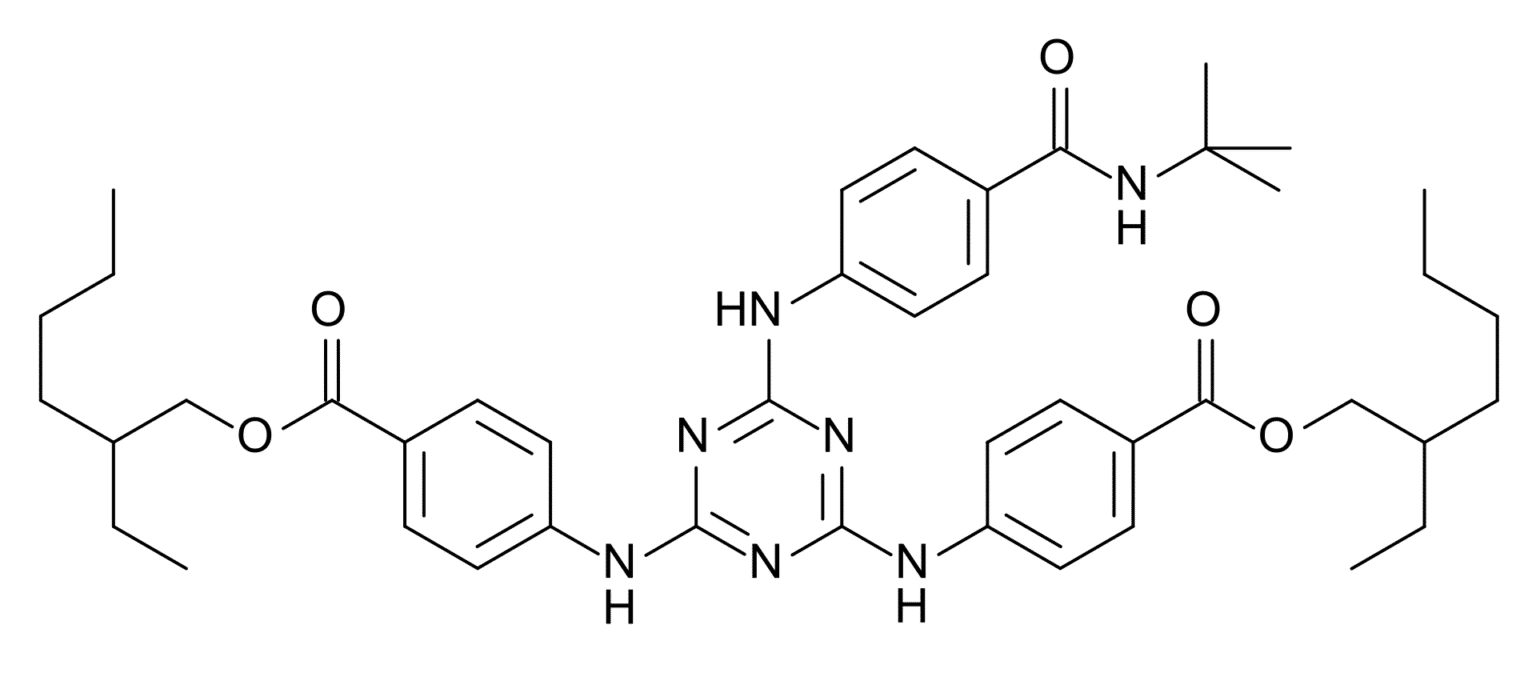
Iscotrizinol, listed on ingredient labels as diethylhexyl butamido triazone and sold under the trade name Uvasorb HEB, belongs to the triazine family of organic UV filters. It is oil-soluble, which makes it well suited to water-resistant formulations, and it contributes meaningfully to SPF at low concentrations — so formulators can reach high protection without the heavy, greasy feel that comes from loading a product with older filters.
It also stabilizes other filters in the same formula. That matters more than it sounds: a sunscreen is only as good as its least stable ingredient, and pairing a fragile filter with a robust one is a large part of how modern European and Asian sunscreens achieve protection that holds up over a day.
Is iscotrizinol FDA approved?
No. Iscotrizinol is not approved for use in sunscreens in the United States. You will not find it in any sunscreen sold legally on a US shelf, and a product containing it cannot be marketed here as a sunscreen.
For 25 years that was effectively the end of the conversation. It no longer is.
On June 9, 2026 the FDA issued a final administrative order recognizing bemotrizinol as generally recognized as safe and effective at concentrations up to 6% — the first new over-the-counter sunscreen filter cleared in roughly two decades. It moved through the streamlined monograph pathway created by the CARES Act, going from proposed order in December 2025 to final order in about seven months.
What makes that significant for iscotrizinol is not the ingredient itself but the precedent. The old process, under which a filter could sit in review for two decades without resolution, is not the process that just approved bemotrizinol. A workable route now exists, and it has been shown to move in months rather than decades.
That route still has to be walked. An approval requires a sponsor — usually the manufacturer — to file an order request with the safety data the FDA asks for, and no such approval has been announced for iscotrizinol. So the honest answer for anyone reading this in 2026 is that iscotrizinol is unapproved in the US, but the reason has shifted from the system being broken to no one having filed yet. Those are different problems, and the second one is solvable. I track the full picture on my FDA sunscreen filter approval tracker.
What it protects against
- UVB (290–320 nm): High — above 85%
- UVA II (320–340 nm): Moderate — 50–85%
- UVA I (340–400 nm): Low — under 50%
- Visible / HEV light: Low — under 50%
The practical reading: iscotrizinol is a strong UVB and short-wave UVA filter, not a long-wave UVA filter. It is a component of broad-spectrum protection, not broad-spectrum protection by itself. In well-built European and Asian formulas it appears alongside a long-wave UVA filter, which is where the deeper pigment and photoaging protection comes from. My UV filter comparison shows how the ranges overlap.
This matters clinically for anyone managing melasma or post-inflammatory hyperpigmentation, where long-wave UVA and visible light drive much of the problem. A sunscreen carrying iscotrizinol and nothing else in the long-wave range is not the right choice for those patients — see my picks for the best sunscreens for melasma.
Why photostability matters
Iscotrizinol loses roughly 10% of its SPF capacity after 25 hours of sun exposure. For comparison, the conventional benchmark for a photostable filter is holding up for two hours.
In practice, reapplication remains the rule regardless — sunscreen comes off through sweat, water, and touch long before it degrades chemically. But formula stability is why some sunscreens still perform at hour six of a beach day and others quietly stop working, and it is a large part of why patients returning from Europe or Korea often report that a sunscreen there felt different.
Where you can find it
Iscotrizinol is permitted at up to 10% under EU cosmetics regulation, and it is approved across much of Asia. It appears in European, Korean and Japanese sunscreens, often in the high-SPF, high-UVA-rating products that Americans notice when traveling. My guide to approved sunscreen UV filters by country lays out where each filter is permitted.
Bringing sunscreen home for personal use is legal. Buying it is not the same as buying an FDA-regulated product, and the labeling standards differ — European PA and UVA-circle ratings measure UVA protection differently than the US broad-spectrum designation does.
Key specifications
- Chemical class: Triazines
- Molecular formula: C₄₄H₅₉N₇O₅
- Molecular weight: 765.98 g/mol
- Peak absorption: 310 nm
- Solubility: Very soluble in oils and alcohols; insoluble in water
- Trade name: Uvasorb HEB (3V Sigma)
Safety profile
Iscotrizinol is a large molecule — molecular weight of about 766 g/mol — and molecular size is one of the main reasons a topical ingredient stays on the surface of the skin rather than passing through it. Safety data describe it as non-irritating and non-sensitizing, with no meaningful systemic absorption in the available studies.
That size is also why it has not attracted the systemic-absorption concerns raised about smaller, older filters such as oxybenzone. It is a different class of molecule, and the comparison is not a useful one.
Common questions
Is iscotrizinol the same as bemotrizinol?
No. Both are triazine filters and their names are easy to confuse, but they are different molecules with different absorption profiles. Bemotrizinol covers a broader range including long-wave UVA and was approved by the FDA in June 2026. Iscotrizinol has not been approved in the US.
Is iscotrizinol safe?
Available safety data describe it as non-irritating and non-sensitizing, and its molecular size argues against meaningful skin penetration. It has been in use across Europe and Asia for years.
What is Uvasorb HEB?
Uvasorb HEB is the trade name under which iscotrizinol is sold by 3V Sigma. If you see it on a technical datasheet or a European label, it is the same ingredient.
Can I buy sunscreen with iscotrizinol in the US?
Not from a US retailer as a sunscreen. It can be purchased abroad, and bringing sunscreen back for personal use is permitted.