
Does Skin Tighten After Weight Loss? What to Expect and What Helps
Medically reviewed by Jane Yoo, MD, board-certified dermatologist and Mohs surgeon.
The short answer: sometimes, partly, and slowly. Skin can keep retracting for months after your weight stabilizes, but how much it recovers depends mostly on your age, how much weight you lost, and how long your skin was stretched. There is no guarantee, and no cream will do it for you.
How skin tries to tighten
Skin contains collagen and elastin that let it stretch and snap back. When the tissue underneath shrinks, your skin has to contract to follow. Younger skin with good collagen and a modest amount of stretching usually retracts better. Older skin, skin that was stretched for years, and skin with sun damage retracts less.
What predicts how much will How long should I wait?
|
Factor |
Usually better for tightening |
Usually worse for tightening |
|---|---|---|
|
Age |
Younger |
Older |
|
Weight lost |
Smaller amount |
Large amount |
|
Speed of loss |
Gradual |
Rapid |
|
Time at higher weight |
Short |
Many years |
|
Sun and smoking history |
Little |
Heavy |
|
Genetics |
Elastic family skin |
Early sagging runs in the family |
How long should I wait?
Skin often continues to adapt for several months after your weight stabilizes, and some people see changes for a year or longer. If you have kept a stable weight for around six to twelve months and your skin still hangs or bothers you, it is reasonable to stop waiting and talk to a clinician. These timelines vary by person and I would treat them as rough guides, not promises.
What actually helps your skin do its best
- Lose weight gradually when you can. Talk to your prescriber about pace; do not change medication on your own.
- Build muscle. Weight loss takes some muscle along with fat. A 2026 meta-analysis found lean mass accounted for roughly 25% to 39% of weight lost with GLP-1 and related medications, about the same as lifestyle weight loss. Resistance training and enough protein, as your care team advises, help preserve the muscle that supports your contour.
- Protect your skin from the sun. UV light breaks down collagen. See my sunscreen guide.
- Do not smoke. Smoking accelerates collagen breakdown.
- Use a retinoid on the face, neck and chest, if it suits your skin. It is one of the few topicals with good evidence for supporting collagen.
- Stay hydrated and eat enough protein. These support healthy skin but do not tighten it on their own.
What does not help
- “Skin-tightening” lotions and body wraps
- Collagen supplements, for which evidence is limited and mixed
- Rapid, repeated dieting that keeps stressing the skin
A quick self-check
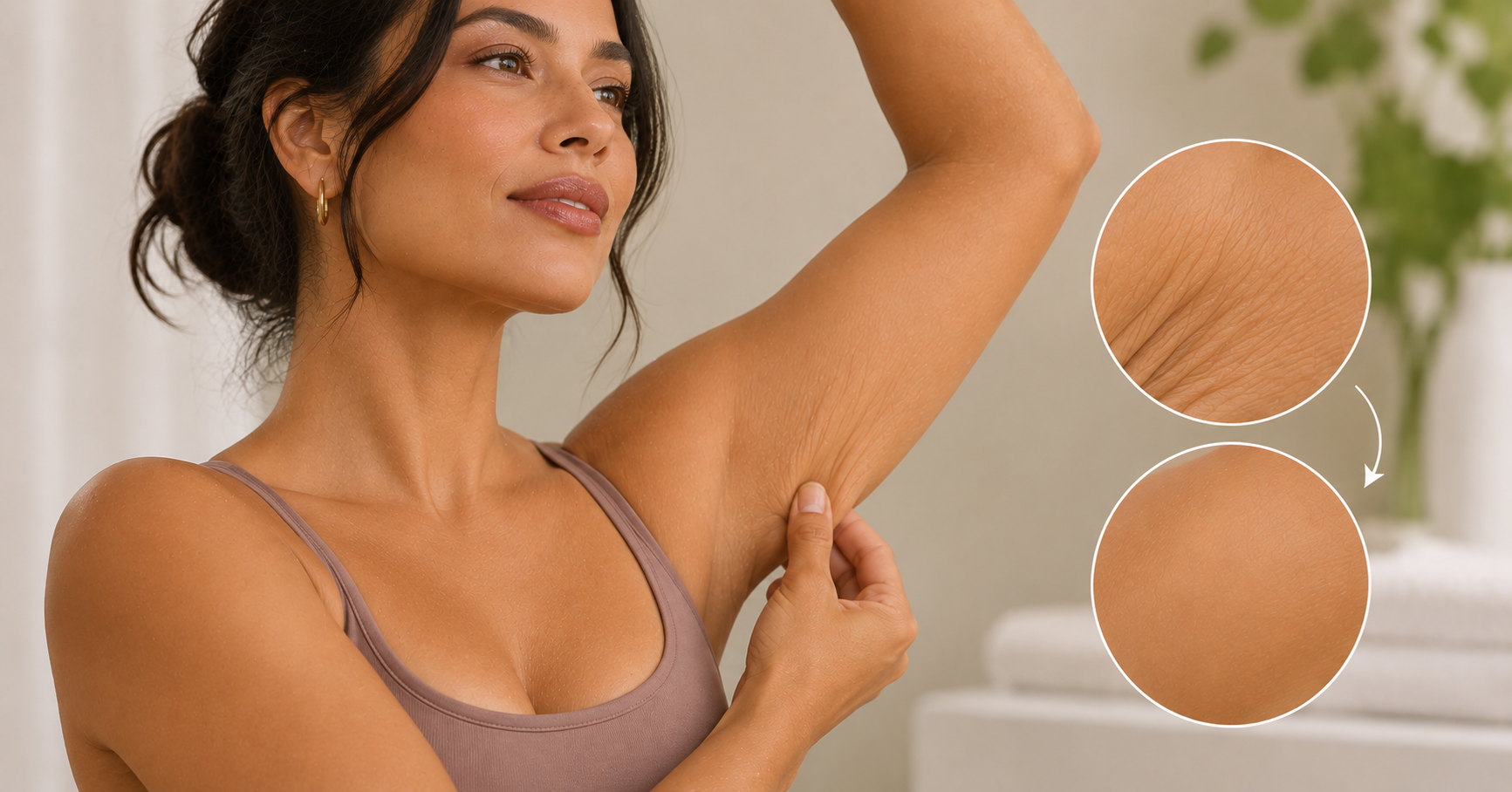
Stand in good light and gently pinch the loose area, then release it.
- It snaps back quickly: your skin is still elastic and may keep improving.
- It returns slowly or hangs: collagen and elastin have taken more damage.
- There are folds that stay folded: this is a structural problem that creams and devices rarely fix.
If you are still not happy
For mild to moderate laxity, in-office treatment such as radiofrequency, RF microneedling and fractional laser can improve firmness and texture; see Loose Skin After Weight Loss. For large amounts of excess skin, a body contouring consultation is the right step, and I can refer you.
For face and neck changes after weight loss, see Ozempic Face.
Frequently asked questions
Will my skin tighten after losing 20 pounds? Often yes, partly, especially if you are younger and lost gradually. Bigger losses carry more risk of lasting looseness.
Does loose skin ever fully go away? Mild looseness may. Significant looseness often does not.
How soon after weight loss can I treat loose skin? Collagen-building treatments can start earlier. Decisions about removing excess skin are best made once weight is stable.
Do GLP-1 medications cause loose skin? The medication does not directly loosen skin. Loose skin follows from how much and how fast the weight comes off.
Not sure where your skin falls? Book a consultation for a skin assessment with Dr. Yoo.



Leave A Comment