
Monopolar radiofrequency (RF) has become one of the more reliable non-surgical options for early to moderate skin laxity. Two of the devices patients ask about most are Everesse (sold outside the US as Volnewmer) and XERF. Here’s how they actually differ.
How Does Monopolar RF Work?
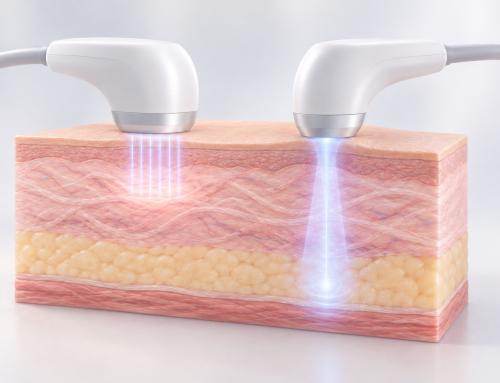
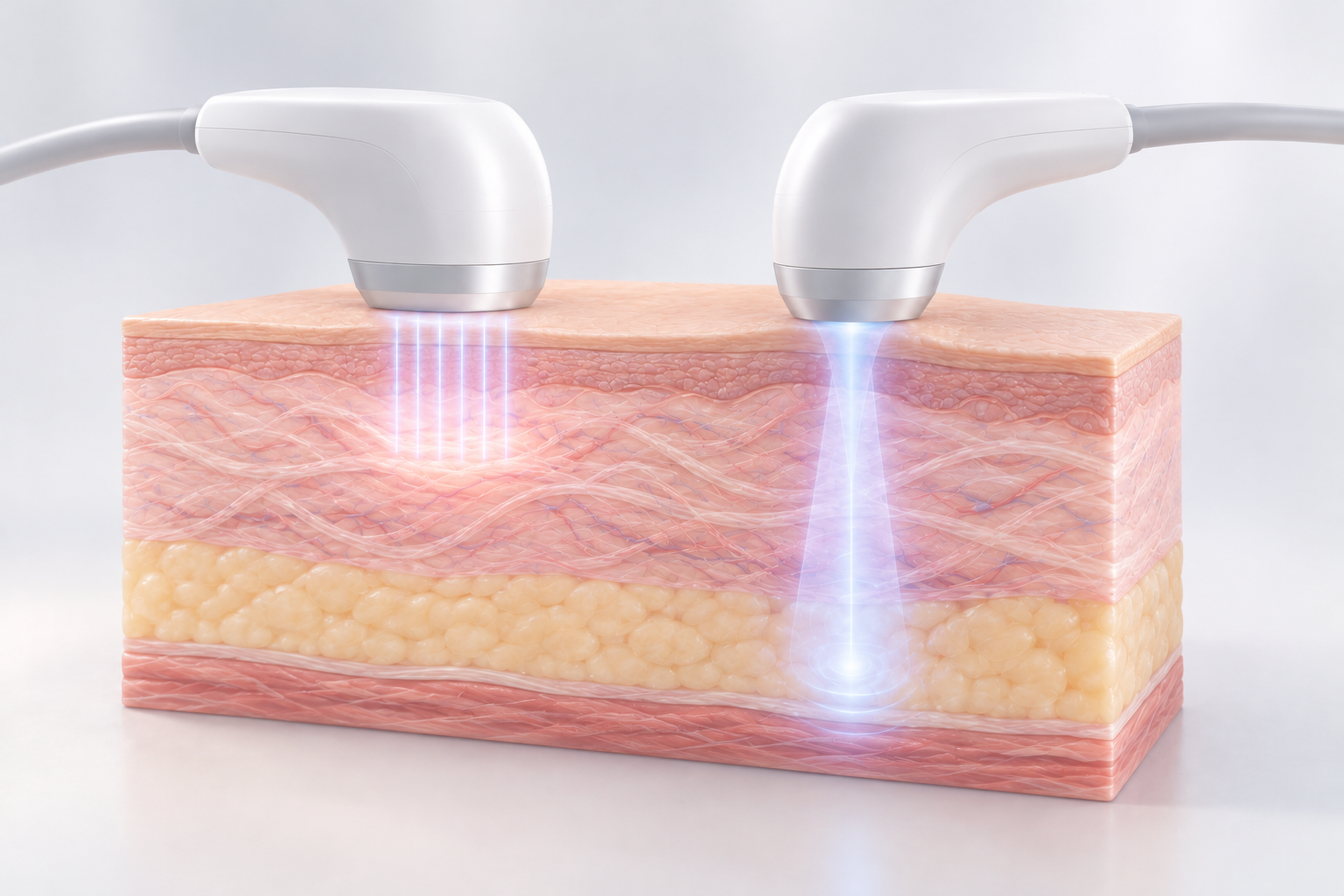
Monopolar RF delivers radiofrequency energy through a single electrode, heating tissue at controlled depths. That heat triggers collagen contraction right away and new collagen production over the following months.
The frequency and delivery pattern determine how deep the energy goes and how it is distributed. That is where these two devices diverge.
What Is Everesse (Volnewmer)?
Everesse, made by Classys and the device I use in my practice, delivers 6.78 MHz monopolar RF through a single electrode. It targets both the papillary and reticular dermis in one pass, an approach the manufacturer describes as “double depth,” to trigger collagen remodeling while protecting the epidermis.
In my practice, I use it for early to moderate laxity. I’ve also found it useful for patients dealing with accelerated collagen loss after rapid weight loss on GLP-1 medications, a use I cover in more detail in [Link: Ozempic face post].
What Is XERF?
XERF, from Cynosure Lutronic, takes a different technical approach. It is a dual-frequency system that combines 6.78 MHz and 2 MHz in a single pulse.
The idea is that the higher frequency concentrates energy in the dermis and fibrous collagen structures, while the lower frequency reaches deeper into subcutaneous tissue. One pass addresses more than one depth at the same time. It also uses integrated cooling to keep the skin surface comfortable during treatment.
I don’t currently offer XERF in my practice. This section is educational, not a services page.
Which Approach Fits Which Patient?
- Single-frequency, double-depth RF (Everesse/Volnewmer): tends to suit patients with earlier-stage laxity who want a well-established, single-pass approach.
- Dual-frequency RF (XERF): built around reaching multiple tissue depths in one pulse, which may appeal to patients looking for a more comprehensive single-session approach.
Neither is a substitute for ultrasound-based tightening such as Sofwave or Ultraformer. If you’re deciding between RF and ultrasound rather than between two RF devices, see [Link: Sofwave vs. Ultraformer MPT post]. I keep these comparisons within one technology rather than mixing them, because the mechanisms aren’t directly comparable.
What Does Recovery Look Like?
Both are generally low-downtime. Most patients return to normal activity the same day, with some temporary redness. Collagen remodeling and visible tightening develop gradually over the following months, not immediately.
FAQ
Is this the same as Morpheus8?
No. Morpheus8 is a microneedling RF device that delivers energy through needles into the skin. Everesse and XERF both apply monopolar RF to the skin surface without needles, so the mechanism and recovery are different.
How many sessions do I need?
This varies by device and by how much laxity you’re treating. It’s best discussed at a consultation rather than generalized here.






Leave A Comment