K-Beauty Immersion at NYSCC Suppliers’ Day: What Happened When an Entire Industry Finally Took K-Beauty Seriously
By Dr. Jane Yoo, MD, MPP, Board-Certified Dermatologist & Mohs Surgeon
Let me start somewhere that might surprise you, given that this is a cosmetic science conference recap.
Think about 2019. A Korean film, a dark, genre-bending thriller about class and inequality, wins Best Picture at the Academy Awards. Not Best Foreign Language Film. Best Picture. A first in Oscar history. Then a Korean pop group dominates the Billboard Hot 100 and sells out stadiums across America. A Korean survival drama drops on Netflix and becomes the most-watched series in the platform’s history.
Now ask yourself: why am I telling you this at a beauty industry event?
Because K-beauty is not separate from this cultural moment. It is part of this moment. The same creative force that produced Parasite, BTS, and Squid Game also produced the 10-step routine, the essence, the cushion foundation, and some of the most scientifically sophisticated UV filters in the world. Korea figured something out about craft, precision, and the intersection of quality and storytelling that the rest of the world is still working to fully understand.
That is why I built this day.
A First-of-Its-Kind Program
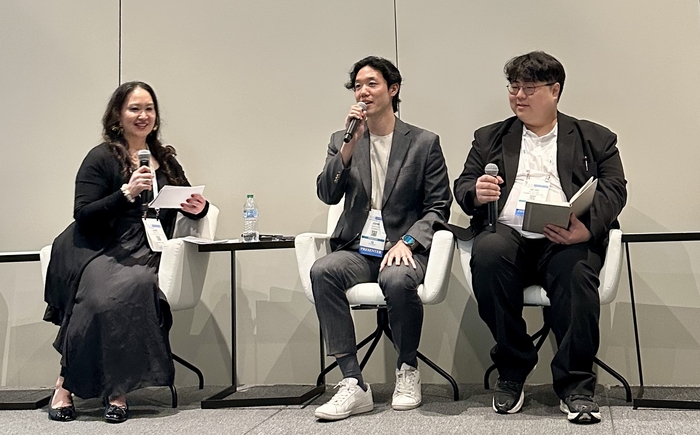
On May 19, 2026, the New York Society of Cosmetic Chemists hosted K-Beauty Immersion, and for the first time in the history of a major U.S. cosmetic industry event, K-beauty had an entire dedicated platform. Not a trend panel tucked into a corner. Not a side session. A full half-day program at the Javits Center, assembled to treat K-beauty as what it actually is: a serious subject of scientific and strategic inquiry.
As the curator and moderator, I will be honest. Building this program was an act of conviction. K-beauty has earned genuine scientific credibility. Its emphasis on barrier health, inflammation control, and early intervention has not just reshaped consumer routines. It has quietly reoriented R&D strategy and clinical thinking worldwide. Our job that morning was to move beyond trend-spotting and into translation.
Here is what we covered.
The Data Told a Compelling Story
We opened with the market intelligence that formulators and executives need to hear before anything else. Addison Cain from Spate, a platform analyzing over 20 billion online search signals and 40 million beauty TikTok videos, and Anna Mayo, Vice President of NielsenIQ’s Beauty Vertical, laid out a forward-looking picture of where K-beauty is actually heading in 2026.
What emerged was not a bubble about to burst. It was a category in structural growth, with ingredient cycles accelerating, hero formats such as toner pads, serum-in-cream hybrids, and barrier-first essences crossing into mainstream retail, and consumer vocabulary around skin health becoming genuinely sophisticated. The “new glass skin” is no longer surface glow. It is skin resilience. That shift matters enormously for anyone developing products right now.
Inside the Lab: What Cosmax Is Actually Seeing
Next, we heard from John Noh and Se Ho Park of Cosmax, one of Korea’s largest ODM manufacturers and the formulation partner behind hundreds of global brands. This session was, in my opinion, one of the most valuable 20 minutes in the program.
If you want to understand where K-beauty ingredient innovation is going, you talk to the people developing it. What Cosmax shared gave attendees a direct window into the ingredient cycles shaping global product development: the materials moving from R&D into commercial scale, the formulation architectures enabling new texture categories, and the consumer expectations Korean brands are already designing for two or three years before those expectations reach Western shelves.
What Dermatologists Actually Think
I will admit a certain awkwardness in introducing my own session. But switching hats from moderator to speaker was something I had planned from the beginning, because I believe the dermatology perspective on K-beauty is chronically underrepresented in industry conversations.
My session, “Dermatologists on K-Beauty: What Translates Clinically and What Doesn’t,” covered the questions I hear from patients every week. Is double cleansing necessary? Are Korean sunscreens actually better? What should I make of PDRN, spicules, and exosomes?
The short version of what I shared: K-beauty does many things exceptionally well, and dermatology agrees with more of it than you might expect. The emphasis on low-pH formulation, multi-weight hyaluronic acid, ceramide-forward moisturizers, and elegant mineral-chemical hybrid SPFs aligns closely with how evidence-based dermatologists approach barrier support and photoprotection. Where I urge caution is in the trend cycle, especially the speed at which ingredients like spicules and exosomes generate consumer excitement before the clinical literature has caught up. Route of administration matters. Standardization matters. “Trending” is not a clinical indication.
The Inclusivity Imperative
Dr. Hawa Dumbuya, Director of Clinical Research and Medical Affairs at L’Oréal USA Research and Innovation, gave one of the day’s most important talks and one of its most direct.
K-beauty was largely developed for a narrow range of skin tones. The industry knows it. Closing that gap requires rigorous science, not good intentions. Dr. Dumbuya’s work spans an international pigmentary disorder study across 34 countries and nearly 48,000 participants, and she brought that depth to a conversation about what it actually takes to make K-beauty work for every patient I see in my office: the full spectrum of skin tones, barrier profiles, and pigmentation concerns. This is not optional for the future of the category. It is foundational.
The Founder Perspective: Charlotte Cho
After the break, we zoomed out from science and data to something equally important: the cultural conviction that built K-beauty into what it is.
Charlotte Cho, co-founder of Soko Glam and founder of Then I Met You, was my fireside guest, and she did not disappoint. She co-founded Soko Glam in 2012, not from a business plan, but from a genuine obsession with Korean skincare after living in Seoul. She introduced the 10-step routine to American consumers before most people had even heard of an essence.
What struck me most in our conversation was her clarity about curation. Anyone can aggregate products. Charlotte built a point of view. She understood that K-beauty’s appeal to Western consumers was not just about efficacy. It was about a relationship with your own skin. The ritual. The intention. The concept of jeong, which infuses her Then I Met You line. That cultural layer is not separate from the formulation science. It is why people commit to routines.
What Suppliers Are Building
Tom Branna of ECMA moderated our supplier panel, which brought together voices from BASF, Seppic, Equipforskin, and Inolex, each offering a different angle on where ingredient innovation is heading.
The panel confirmed something I have suspected: the raw material side of K-beauty is evolving at least as fast as the finished goods side. What is happening in Korean ingredient R&D, from biotechnology-derived actives to sustainable bio-based chemistries and next-generation sensorial agents, is already influencing what global formulators have access to. The supply chain for K-beauty-inspired formulation is no longer limited to Korean ODMs. It is becoming a global infrastructure.
Why K-Beauty Textures Feel Different and the Science Behind It
Jack Kang, Director of North America R&D at LG H&H, gave the formulation session I personally had been most looking forward to. He tackled the question I get constantly: why does a Korean essence absorb differently than anything else on the market?
The answer is not marketing. It is polymer selection, emulsifier architecture, aqueous-to-oil phase ratios, and the deliberate use of low-viscosity systems that maintain film-former behavior without occlusive drag. The “water cream” category, those impossibly light emulsions that still deliver meaningful actives, is technically demanding to produce. K-beauty R&D centers, particularly at companies like Cosmax and LG H&H, have spent years refining this. The global consumer expectation that “lightweight” and “effective” are not mutually exclusive? Korea built that expectation.
The Ingredient Reality Check
Michelle Shieh, Scientific Communications Associate Director at Amorepacific Americas R&I, gave the session I think the entire room needed: a clear-eyed, responsible look at the ingredients generating the most buzz and the most skepticism.
PDRN. Spicules. Exosomes. These terms are appearing in product launches and brand claims faster than the science communication can keep up. Michelle walked through what is actually supported by data, what is still emerging, and, crucially, how brands should be talking about these ingredients without overpromising or misleading consumers. Topical PDRN and PN-based formulations can function as supportive skincare. Exosome terminology in marketing often outstrips exosome characterization in the lab. Spicules can exfoliate and enhance penetration, but they are not in-office microneedling, and they carry real irritation and PIH risk in susceptible patients.
This kind of honest, nuanced science communication is what builds long-term brand credibility. I was glad we had it.
The SPF Conversation We Have Been Waiting For
We closed the formal program with a session I care about deeply as a practicing dermatologist: Korean SPF innovation and the regulatory future of UV filters in the United States.
Carl D’Ruiz from dsm-firmenich has spent more than 30 years in sunscreen science and regulatory advocacy, including testifying before Congress on the potential approval of new UV filters in the U.S. He chairs the PCPC Sunscreen Consortium. He has done more to advance the possibility of PARSOL® Shield, also known as bemotrizinol, receiving FDA approval than perhaps any other individual in the industry.
Korean sunscreens are elegant, wearable, and high-performance for a reason: Korea has access to UV filter systems that are not yet approved in the United States, where sunscreens are regulated as drugs rather than cosmetics. Filters like Tinosorb S, Uvinul A Plus, and Uvinul T 150 offer superior UVA protection in cosmetically elegant bases, exactly the kind of photoprotection I want my patients using every day. The gap between what is available to Korean consumers and what is available to American consumers is meaningful. We may be closer to closing it than we have been in a generation.
After the Program: The Floor Tour
Following Q&A, attendees joined a hosted networking lunch before a guided tour of K-beauty ingredient suppliers exhibiting on the Suppliers’ Day show floor. This was an intentional design choice: the morning was about strategic context, but beauty is ultimately a tactile industry. Getting formulators and executives face-to-face with the suppliers bringing these innovations to commercial scale, with hands on the materials and conversations with the scientists, is something no panel can fully replicate.
What This Day Meant
I want to be direct about something: the K-Beauty Immersion at NYSCC Suppliers’ Day was the first time a major U.S. cosmetic industry event devoted a dedicated, substantive platform to K-beauty. Not a trend moment. A full program of scientific, clinical, and strategic depth.
That matters, not because K-beauty needs validation from Western institutions, but because the people in that room, including formulators, executives, brand leaders, and ingredient suppliers, are the ones who will shape what the next generation of skincare looks like globally. Giving them a rigorous framework for understanding what K-beauty actually is, what is scientifically credible within it, and where it is heading is how good products get made.
The science is moving fast. The regulatory landscape is shifting. The consumer base is expanding. The innovation, as everyone in Room 1E15 heard that morning, is nowhere near finished.