
Laser Caps and Combs for Hair Loss: Do They Work?
Medically reviewed by Jane Yoo, MD, board-certified dermatologist | Updated November 13th, 2026
Low-level laser therapy (LLLT) devices, sold as laser caps, helmets and combs, are among the few non-drug options with FDA clearance for pattern hair loss. They are easy to use at home and carry few side effects. How well they work is a more nuanced question.
Featured Device: REVIAN RED Hair Growth System
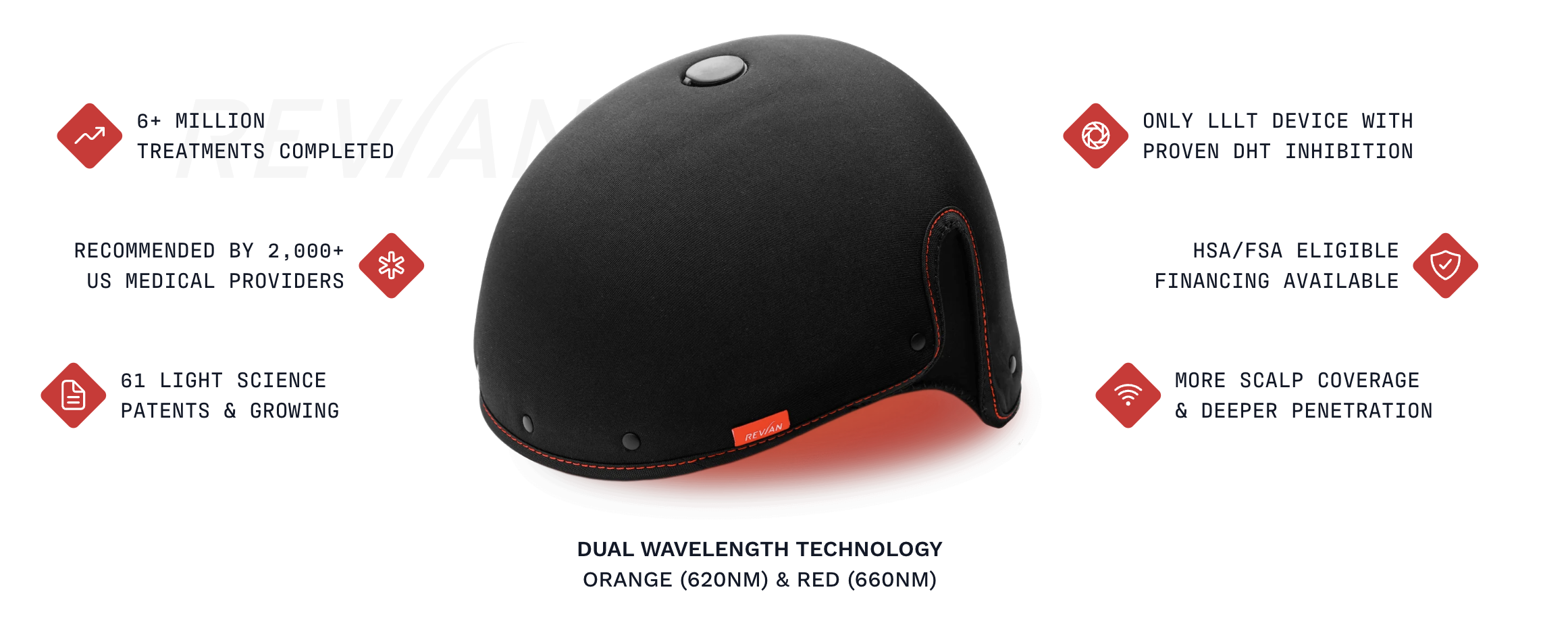
One at-home option for patients considering light-based hair loss treatment is the REVIAN RED Hair Growth System, an FDA-cleared, wearable LED device designed for androgenetic alopecia (pattern hair loss). The device uses dual-wavelength red light (620 nm and 660 nm) and requires just 10 minutes of daily treatment.
In a small, randomized, placebo-controlled study, REVIAN RED demonstrated improvements in hair density after 16 weeks of consistent use. Although these findings are encouraging, results vary, and red light therapy is best considered as an adjunct to established hair loss treatments rather than a replacement for medical evaluation.
Interested in trying REVIAN RED? Patients can purchase the device directly through the manufacturer’s website and use our exclusive promotional code yoomdhair at checkout for applicable savings.
—
How LLLT works
These devices deliver low-energy red light, typically in the red wavelength range, to the scalp. The leading theory is that the light is absorbed by cells in the follicle and may stimulate cellular energy production, extend the growth phase and reduce inflammation. The precise mechanism in human hair follicles has not been proven.
FDA cleared, not approved
Several laser hair devices have been cleared by the FDA through the 510(k) pathway for androgenetic alopecia in men and women. Clearance means the agency found a device substantially equivalent to a previously cleared device and acceptably safe. It is a lower bar than FDA approval of a drug and does not by itself prove strong effectiveness.
What the evidence shows
- Randomized, sham-controlled trials and meta-analyses generally show increases in hair density with LLLT compared with sham devices in men and women with pattern hair loss.
- The improvements are typically modest.
- Many studies are small, short and funded by manufacturers, and devices differ in wavelength, power, coverage and schedule.
- There is limited evidence for LLLT in other hair conditions.
- LLLT has been compared less often against minoxidil or finasteride directly, so how it stacks up is not well established. It is more often used as an add-on.
Who may benefit
- People with early to moderate pattern hair loss who want a drug-free option or an add-on to medication.
- People who cannot take, or prefer not to take, minoxidil or DHT-blocking medicines.
- People who are consistent and willing to use a device on schedule for many months.
Who may not
- People with extensive baldness and few remaining follicles.
- People with scarring alopecia or an unexplained scalp condition, who should be evaluated first.
- People with photosensitivity, or who take photosensitizing medications, should check with their clinician.
What to look for in a device
- FDA clearance for hair growth, which you can verify with the manufacturer or in the FDA database. Many “red light” products are not cleared for hair loss.
- Full scalp coverage appropriate to your pattern of thinning.
- A schedule you can actually keep, since results depend on regular use.
- Independent evidence, not only the manufacturer’s own materials.
Using it well
Follow the device instructions on session length and frequency. Results, if they come, usually take several months, so judge with photographs taken at the same angle and lighting. Benefits are expected to last only while you continue using the device. Side effects are uncommon and mild, such as scalp warmth, tingling or dryness.
For comparison with other treatments and the full evidence tiers, see our pillar guide to hair loss treatment, and our guides to minoxidil and PRP. If you are interested in at-home light devices for skin, see our K-beauty devices guides.
—
Frequently asked questions
Do laser caps really work for hair loss?
Sham-controlled trials generally show modest increases in hair density in pattern hair loss, but studies are often small and manufacturer-funded. They are FDA-cleared and low-risk, best used with proven treatments.
Is a laser cap FDA-approved?
Several are FDA-cleared through the 510(k) pathway, which is not the same as FDA approval of a drug. Check that a specific device is cleared for hair loss.
How long until a laser cap shows results?
Usually several months of consistent use, and benefits typically fade if you stop.
—
Concerned about hair thinning or shedding? Dr. Jane Yoo is a board-certified dermatologist in Midtown Manhattan. A proper diagnosis comes first, because the right treatment depends on the type of hair loss. Book a consultation.
This article is for educational purposes and does not replace an in-person medical evaluation.